
In this guide
- Two kinds of series light, two kinds of connection
- Series light connection diagram: parallel, never end to end
- What a series light jointer is, and when you need one
- How many strings one socket can carry
- How to connect series lights, step by step
- The series light connector on the string itself
- Series light adapter: the low-voltage case
- Can you connect two series lights together?
- Safety: the circuit behind the connection
- Common mistakes in series light connection
- The short version
Short answer: give every 220 V series light its own socket. Plug each string into an extension board or a jointer so it gets the mains directly, and never plug one string into the tail of another. Low-voltage strings run from the adapter they came with, one string per adapter. That is the whole of series light connection for a home, and the rest of this guide explains the jointer, the adapter, the load maths and the mistakes.
Everything here involves 220 V mains. Unplug before you touch a connector, and nothing on this page involves cutting a wire or opening a controller.
Two kinds of series light, two kinds of connection
The confusion around series light connection starts with the fact that two very different products share the name. Which one you have decides everything that follows.
| Kind | Runs on | Comes with | How it connects | Examples |
|---|---|---|---|---|
| Mains string | 220–240 V AC | A moulded plug and an inline controller on the lead | Straight into a wall socket, board or jointer. One string per socket. | Rice light, pixel series, ladi, most Diwali strings |
| Low-voltage string | 5 V USB, or 12, 24 or 31 V DC | A USB lead or a small adapter with a barrel plug | Into the adapter it came with, one string per adapter | Copper wire fairy lights, battery strings, bottle lights |
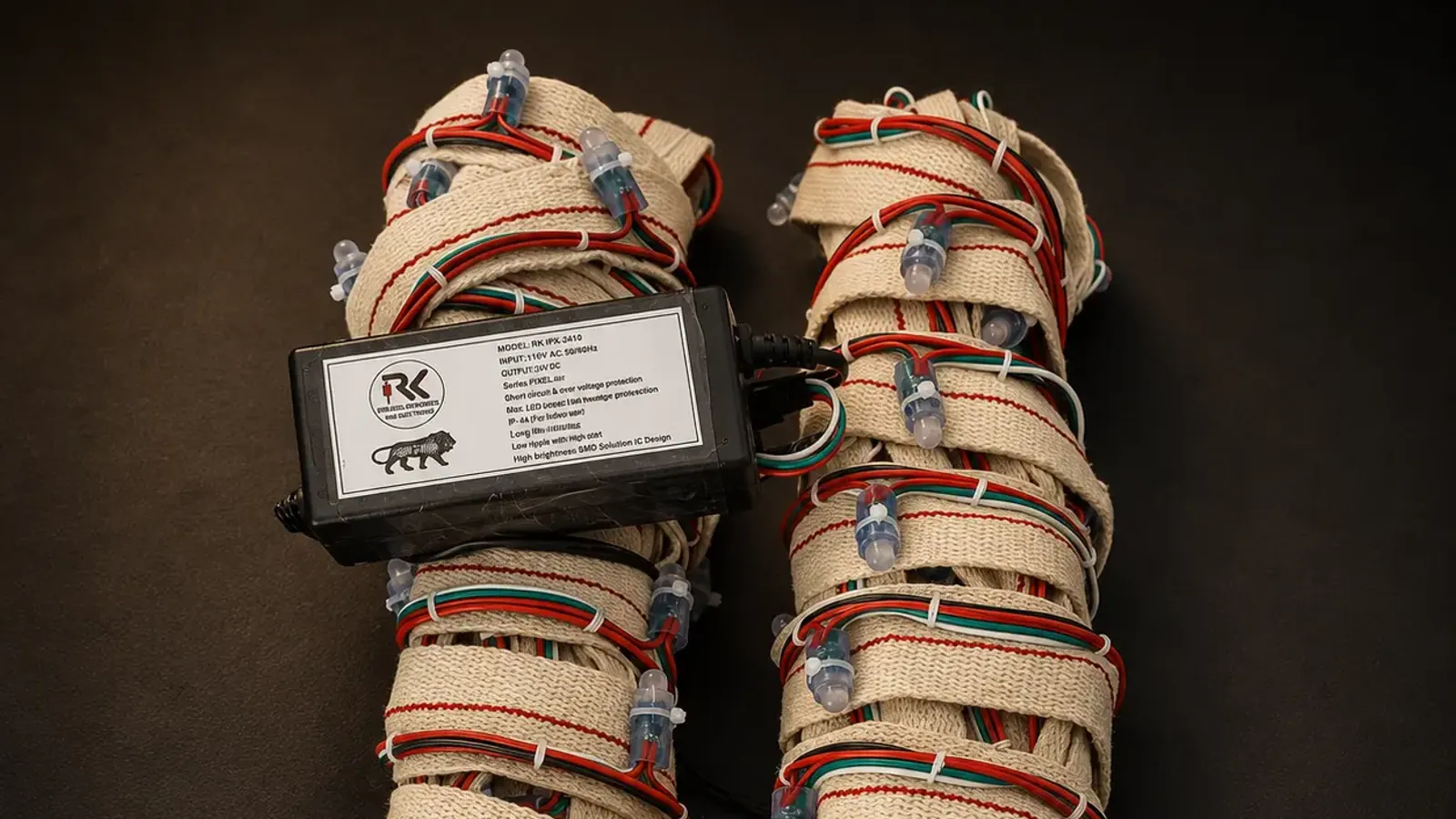
Our Rice Light Series and Pixel Blinking Series are the first kind. They plug into the wall, the controller sits a few centimetres from the plug, and there is no adapter to lose or mismatch. Nearly every string sold for a facade, a balcony railing or a shop front in India is this kind too, whether the listing calls it a rice light, a pixel light or a ladi, which is why the rest of this guide is mostly about mains strings and comes back to adapters near the end.
Series light connection diagram: parallel, never end to end
Inside a single string the LEDs are wired in series, in sections of ten to fifty, which is why one failed LED darkens the whole section after it. That is the string's business and you cannot change it. Between strings, the connection is your business, and it must be parallel: one trunk from the wall, and every string hanging off that trunk on its own socket.
The reason is the controller. On a mains string the controller is sized for the current of the string it came on. Plug a second string into the tail of the first and the first controller now carries the current of both, the second string has no controller of its own so it can only copy whatever mode the first is in, and the small push-fit connector at the join was never meant to pass current onward. It works for an evening. Over a fortnight the first controller runs warm, then hot, and that is how a series light connection turns into a melted box behind the curtain.
Parallel costs nothing extra. An extension board is a parallel connection. A jointer is a parallel connection. Three wall sockets in three rooms are a parallel connection. The only thing that is not parallel is the tail of one string going into the head of the next, and that is the one thing to avoid.
What a series light jointer is, and when you need one
A jointer, also sold as a ladi jointer, a ladi connector or a series light connector wire, is a length of twin-core wire with female sockets moulded into it every 30 to 60 centimetres, and one plug at the end. They are sold by socket count: 9+1, 12+1, 16+1, 19+1, meaning that many sockets plus the one plug. Each socket takes the plug of one string. Ladi is simply the North Indian word for a decorative string, so a ladi jointer and a series light jointer are the same object.
It exists for one job: running many strings along a long run from one wall socket, in parallel, without a mess of extension boards. A building facade, a compound wall, a shop front, a wedding house, a society ground at Navratri. You fix the jointer along the wall first, then plug a string into each socket and let each string hang or run from there.
It is the wrong tool for a single balcony. A balcony takes one or two strings, and an extension board just inside the door does the same job with the sockets protected from rain. The Diwali balcony layouts never need a jointer, and a 2BHK done room by room is three or four strings on three or four sockets that already exist.
| Setup | Strings | Best series light connection |
|---|---|---|
| One balcony, railing and sides | 1–2 | Extension board inside the door |
| 2BHK, balcony plus door plus windows | 3–4 | The nearest wall socket in each room |
| Main door and porch | 2–3 | One extension board under cover |
| Building facade or compound wall | 8–20 | Jointer fixed along the wall, plug end under cover |
| Shop front, one shutter width | 2–4 | Extension board inside the shutter line |
| Open terrace parapet | 3–6 | Jointer under the parapet lip, or an outdoor-rated board |
How many strings one socket can carry
This is where people over-worry, and the maths is short. A 10 metre LED rice light draws about 5 W. A 15 metre pixel string with its controller draws under 10 W. Even the long 50 and 100 metre marketplace strings rarely pass 30 W. Current is watts divided by volts, so at 230 V a 10 W string is about 0.04 A.
| Strings on one jointer or board | Total load | Current at 230 V | 6 A socket |
|---|---|---|---|
| 4 × 10 W | 40 W | 0.17 A | Trivial |
| 8 × 10 W | 80 W | 0.35 A | Trivial |
| 16 × 10 W | 160 W | 0.70 A | Fine |
| 19 × 10 W | 190 W | 0.83 A | Fine |
| 19 × 30 W long strings | 570 W | 2.5 A | Fine, but check the jointer wire |
| Add one 2000 W room heater | 2,170 W | 9.4 A | No. Heater on its own 16 A socket |
The wall socket is never the limit for LED strings. Three other things are.
The jointer's own wire. Every string's current passes down that one twin-core wire to the plug. Cheap jointers use thin copper-clad aluminium that warms under a full load of long strings. Buy copper conductor of at least 0.75 square millimetres, from an electrical shop rather than a festival stall. The difference is ₹50 and it is the one part of the setup that carries everything.
The exposed sockets. A jointer's sockets are open holes in a plastic moulding with no IP rating at all. Under a slab or a ledge they are fine. In rain they are the least protected part of the whole installation, worse than an IP20 string. Fix the jointer where the wall shelters it, or face the sockets downward under a lip, and keep the plug end indoors. The difference between IP44 and IP65 applies to the strings; the jointer has neither.
What else is on the circuit. A board carrying eight strings is carrying almost nothing. The same board also running a room heater, an iron or a kettle is how boards melt. Keep decorative lighting on its own board and its own switch.
How to connect series lights, step by step
The order matters. Testing after fixing is how a Saturday disappears.
- Count strings and sockets. Work out how many metres and how many strings the run takes, then count the sockets you have within 2 metres of it. The gap between the two numbers is what the extension board or jointer fills.
- Test every string on its own first. Plug each one directly into a wall socket, run through the modes, and look for a dark section. Do this on the floor, before anything is fixed. A faulty string is a WhatsApp message now and an hour on a ladder later.
- Place the board or jointer under cover. Board inside the door for a balcony. Jointer along the wall under the slab or a ledge for a facade, with its plug end reaching an indoor socket. Nothing with an open socket goes where rain lands.
- Fix the jointer wire before the strings. Cable ties or clips every 40 to 50 centimetres, sockets facing down. A jointer left to hang saws through its own insulation on the edge of the wall in a week of wind.
- Plug strings in one at a time and check each. If a string that worked on the floor is dark on the jointer, the socket on the jointer is the fault, not the string. Move it one socket along and mark the dead one.
- Route wires over frames, never through sliding tracks. Over the top of the door frame or under the fixed pane. A wire in the sliding track is crushed a little more every time the door closes and fails three weeks in.
- Park every controller under cover. The LEDs can be out on the railing or the wall. The controller and plug of each string stay dry, tucked under the slab or inside, whatever the string's rating.
- Set the modes, then leave them. Each string keeps its own controller, so patterns on a jointer will never run in step. Steady or slow fade on every string looks intentional. Eight strings chasing out of sync looks like a fault.
- Switch off from the board. One switch on the extension board or at the wall socket turns the whole run off at bedtime. Do not leave a jointer live and unattended overnight.
The series light connector on the string itself
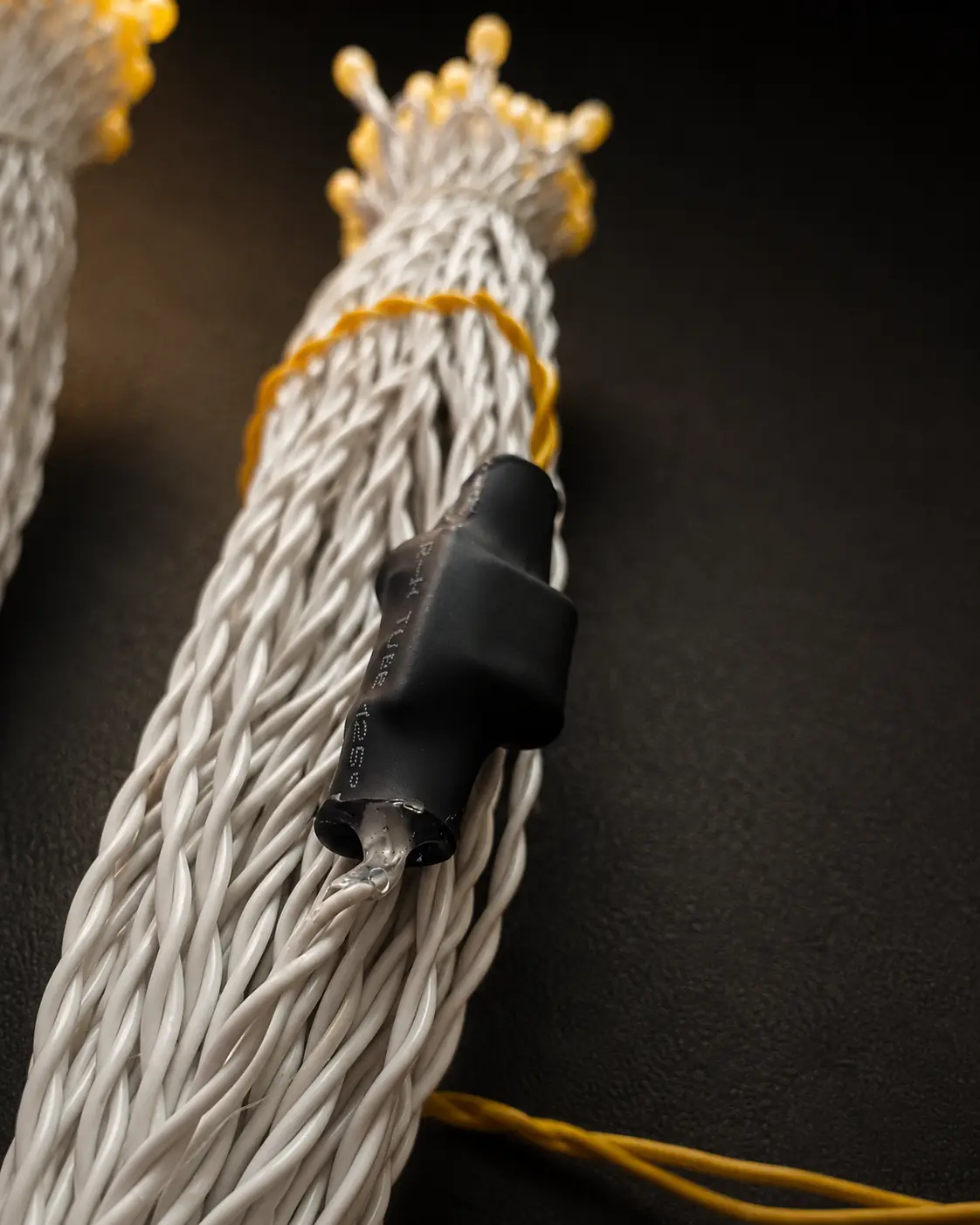
Many mains strings have a small push-fit connector a few centimetres from the controller, where the lead joins the string, and sometimes a second one at the plug. These are the "series light connector" people search for when a string goes dark, and they are the second most common fault on a working string. They vibrate apart on a railing in wind and get tugged when a curtain is drawn across them. The fix is to unplug, push the two halves firmly together until they click, and plug back in. The full order of checks is in the guide to a series light that has stopped working.
What the connector is not is a place to join two strings, and it is not a place for a generic splice. Twist-and-tape joins, screw connectors meant for house wiring, and the transparent clip connectors sold for LED strips have no business on a 220 V decorative string. If the string arrived without a plug, the answer is a proper two-pin plug with the wires under its screw terminals, which the troubleshooting guide walks through, and never bare wire into a socket.
Series light adapter: the low-voltage case
Copper wire fairy lights, bottle lights, battery strings and most USB strings run at 5 to 31 V DC, and the adapter is their series light connection to the mains. The rules are short and every one of them matters.
- Match the voltage. The string's label says 5 V, 12 V, 24 V or 31 V. The adapter's output must say the same. A 12 V string on a 24 V adapter burns out in seconds; a 24 V string on a 12 V adapter glows dimly or not at all.
- Match the polarity. DC barrel plugs have a centre pin that is positive on most strings and negative on a few. The symbol on the adapter and the string must agree. Reversed polarity on an LED string usually means nothing lights, not damage, but do not rely on that.
- Match or exceed the watts. An adapter rated at or above the string's wattage runs cool. One rated below it runs hot and fails, sometimes taking the string with it.
- One string per adapter. Unless the string's box says two or more can share an adapter and states the limit, they cannot. The adapter, like the controller on a mains string, was sized for one.
- Keep the DC run short. The thin wire between adapter and string drops voltage over distance. A 2 metre extension on the DC side is fine. A 10 metre one dims the far end noticeably.
- USB from a power bank or a phone charger is fine for a 5 V string; that is what the port is for. A 10 metre USB string draws under 1 A, and a 10,000 mAh power bank runs it for a full evening or more.
A 220 V string and an adapter never meet. If a string has a plug and a controller on the lead, it plugs into the wall. If it has a barrel plug or a USB plug, it plugs into its adapter. There is no third case.
Can you connect two series lights together?
Directly, end to end: only if the box says so, and almost none do. A few commercial Christmas strings, the kind sold by the carton for shop fittings, have a socket moulded on the tail and a printed limit such as "connect up to 5". If your string has that socket and that number, you can chain up to that number and no more. Neither of our strings has it, and neither does any rice light or pixel string we have seen sold for Diwali.
Side by side, in parallel: always, and that is the answer to the question as people actually mean it. Two strings on one extension board light one balcony. Sixteen strings on one jointer light one facade. Each string gets 230 V, each keeps its own controller, and each fails alone, so a dead string on a facade leaves fifteen lit rather than none.
If what you actually want is one continuous run with no visible join, the answer is not a connection at all but a longer string: a 20 metre string rather than two 10s, for the reasons the metres guide covers. A join always shows, and two strings from two batches are rarely the same white.
Safety: the circuit behind the connection
Three things sit behind every series light connection and are worth two minutes each.
The RCD. Anything outdoors on 220 V should be on a circuit protected by an RCD or RCCB, the device on the distribution board that trips on current leaking to earth rather than only on overload. Most flats built after 2010 have one. If yours does not, a plug-in RCD adaptor from an electrical shop costs a few hundred rupees and sits between the wall and the board; it is the single best safety purchase for festive lighting.
Sockets versus plugs. Indian sockets come in 6 A and 16 A. Decorative strings and jointers carry 6 A plugs. Never file a 16 A plug to fit a 6 A socket or force a 6 A plug into a 16 A socket with a matchstick in the earth hole; if the plug does not fit the socket, the socket is telling you it is on a circuit meant for something else.
Children and pets. A jointer along a wall at waist height has open sockets every half metre. Face them downward, tie the strings so no loop hangs at a child's height, and switch the whole run off from one point when nobody is watching it.
Common mistakes in series light connection
- Chaining strings end to end. The first controller carries every string. Parallel, always.
- A jointer on a balcony. One or two strings need an extension board inside the door, not twelve open sockets on the railing.
- A jointer in the rain. Its sockets have no rating. Under a slab or a ledge, sockets down, plug indoors.
- The cheapest jointer. Thin copper-clad wire carrying every string's current. Buy copper, 0.75 square millimetres or more.
- A heater on the lighting board. The strings are nothing; the heater is everything. Separate board, separate socket.
- Swapping adapters between strings. 12 V and 24 V adapters look identical. Read both labels.
- Fixing before testing. Every string on the floor first. Then the ladder.
- Expecting the patterns to sync. Each string has its own controller. Set them all to steady or slow fade and stop fighting it.
The short version
Series light connection has one rule and two tools. The rule: every 220 V string gets the mains directly, on its own socket, never through another string. The tools: an extension board for a balcony or a room, a jointer for a facade or a long wall, both of them parallel connections that let each string keep its own controller and fail on its own. Sixteen LED strings on one jointer draw under an ampere, so the socket is never the limit; the jointer's wire and its open sockets in rain are. Low-voltage strings use the adapter they came with, matched on volts, polarity and watts, one string each. Test every string on the floor, fix the jointer before the strings, keep every controller and every socket under cover, and switch the whole run off from one point at night. Get the series light connection right on the first evening and the strings are the only thing anyone notices for the rest of the festival. If you are unsure whether your run wants a board or a jointer, send us a photo of the wall on WhatsApp and we will tell you.
Common questions
What people ask us about this
- What is the correct series light connection for more than one string?
- Parallel, always. Each 220 V string plugs into its own socket on an extension board or a jointer, so every string receives the mains directly and keeps its own controller. Chaining strings end to end puts the current for every string through the first controller, which was built for one, and it is the most common way a decorative light overheats.
- Can I connect two series lights together?
- Only if the box says the string is connectable and states the maximum number that can be joined. Almost no decorative string sold in India does, and neither of ours is rated for it. The safe series light connection for two strings is two sockets, or one extension board with both strings plugged into it side by side.
- What is a series light jointer, and what is a ladi jointer?
- The same thing. A jointer is a length of twin-core wire with female sockets moulded along it at intervals, sold as 9+1, 12+1, 16+1 or 19+1, meaning that many sockets plus one plug. Each socket takes the plug of one string. It lets you run many 220 V strings along a facade or wall from one wall socket, in parallel. Ladi is the North Indian word for a decorative string.
- How many series lights can I connect to one jointer?
- As many as it has sockets, provided the total load is small, and with decorative LED strings it always is. A 10 metre rice light draws about 5 W and a 15 metre pixel string under 10 W, so sixteen strings on a 16+1 jointer is under 160 W, or about 0.7 A at 230 V. A 6 A wall socket carries that easily. The limits are the jointer's own wire, its unprotected sockets in rain, and the fact that each string keeps its own controller so patterns never sync.
- Do series lights need an adapter?
- Only low-voltage strings do. USB fairy lights run at 5 V and DC copper wire strings at 12 V, 24 V or 31 V, and each comes with the adapter that steps the mains down to that voltage. Our rice light and pixel series are 220 to 240 V strings that plug straight into the wall, with the controller inline on the lead, and need no adapter at all.
- Can I run a series light from a 12 V adapter or a battery?
- Only a string sold as a 12 V string. A 220 V string will not light on 12 V and a 12 V string plugged into the mains burns out in a second. Match the voltage on the string's label to the adapter's output, match the polarity on a DC barrel plug, and use an adapter rated at or above the string's wattage. A 12 V string on a 12 V battery works and is how car and camping strings are run.
- What does a series light connection diagram look like?
- Inside a string the LEDs are wired in series, in sections, which is why one dead LED darkens the section after it. Between strings the connection must be parallel: the mains goes to a board or jointer, and each string hangs off its own socket. Drawn out, it is one trunk from the wall with several equal branches, never a single long chain.
- What does a ladi light jointer cost?
- Roughly ₹100 to ₹250 at an electrical shop, depending on the number of sockets and the wire. Pay for copper conductor of at least 0.75 square millimetres and moulded sockets rather than clip-on ones. A jointer is the one part of a festive setup that carries every string's current in one wire, so it is the wrong place to save fifty rupees.
From the shop

