
In this guide
- One product family, five names
- Rice light vs pixel light: the physical difference
- Rice light vs fairy lights
- Pixel light vs string lights
- What is ladi light in English?
- Rice light vs pixel light: which to buy where
- Brightness, spacing and how each photographs
- Price per metre: what the difference buys
- Can you mix rice lights and pixel lights?
- Common mistakes
- The short version
Short answer: a rice light is a string of tiny 2 to 3 mm LEDs on thin wire, dense, cheap and indoor only. A pixel light is a string of bigger 5 mm capped LEDs on thicker wire, brighter, IP44, with a mode controller. Fairy light is the English name for the first kind and in Indian listings usually means a USB or battery string. Ladi and series light mean any mains string. In the rice light vs pixel light decision, pixel goes on the railing and rice goes on everything indoors.
The rest of this guide sorts out the five names, sets the two real products side by side, and says which one belongs in each place, with our prices so you can see what the difference costs.
One product family, five names
The names are the problem. Shops, listings, WhatsApp groups and the electrician all use different words for the same string, and a few of the words mean different things in different places.
| Name | What it usually means in India | Voltage | Where you hear it |
|---|---|---|---|
| Rice light | Mains string of 2 to 3 mm LEDs on thin twin wire, dense | 220 V | Shops, listings, Diwali |
| Pixel light | Mains string of 5 mm capped LEDs on twisted wire, with a controller | 220 V | Shops, listings, decorators |
| Fairy light | Any thin-wire string of small LEDs; in listings, usually copper wire on USB or battery | 5 V USB, 3 V battery, sometimes 220 V | Amazon, Instagram, gifting |
| String light | The general English word; in the West often bulb festoon on a cable | Either | Western sites, some Indian brands |
| Series light, ladi | Any mains decorative string. Ladi is Hindi for a row or garland | 220 V | Electricians, North India, wholesale |
Two of those are products and three are labels. Rice light and pixel light describe what the LED and the wire are. Fairy, string and ladi describe the category, and a rice light or a pixel light can be called any of them depending on who is talking. Our Rice Light Series and Pixel Blinking Series are both 220 V ladi in an electrician's mouth, both series lights on our own site, and both fairy lights to an aunt.
Rice light vs pixel light: the physical difference
Put the two side by side and the difference is obvious in a second. It is worth knowing exactly what you are looking at, because every downstream decision follows from it.
| Rice light | Pixel light | |
|---|---|---|
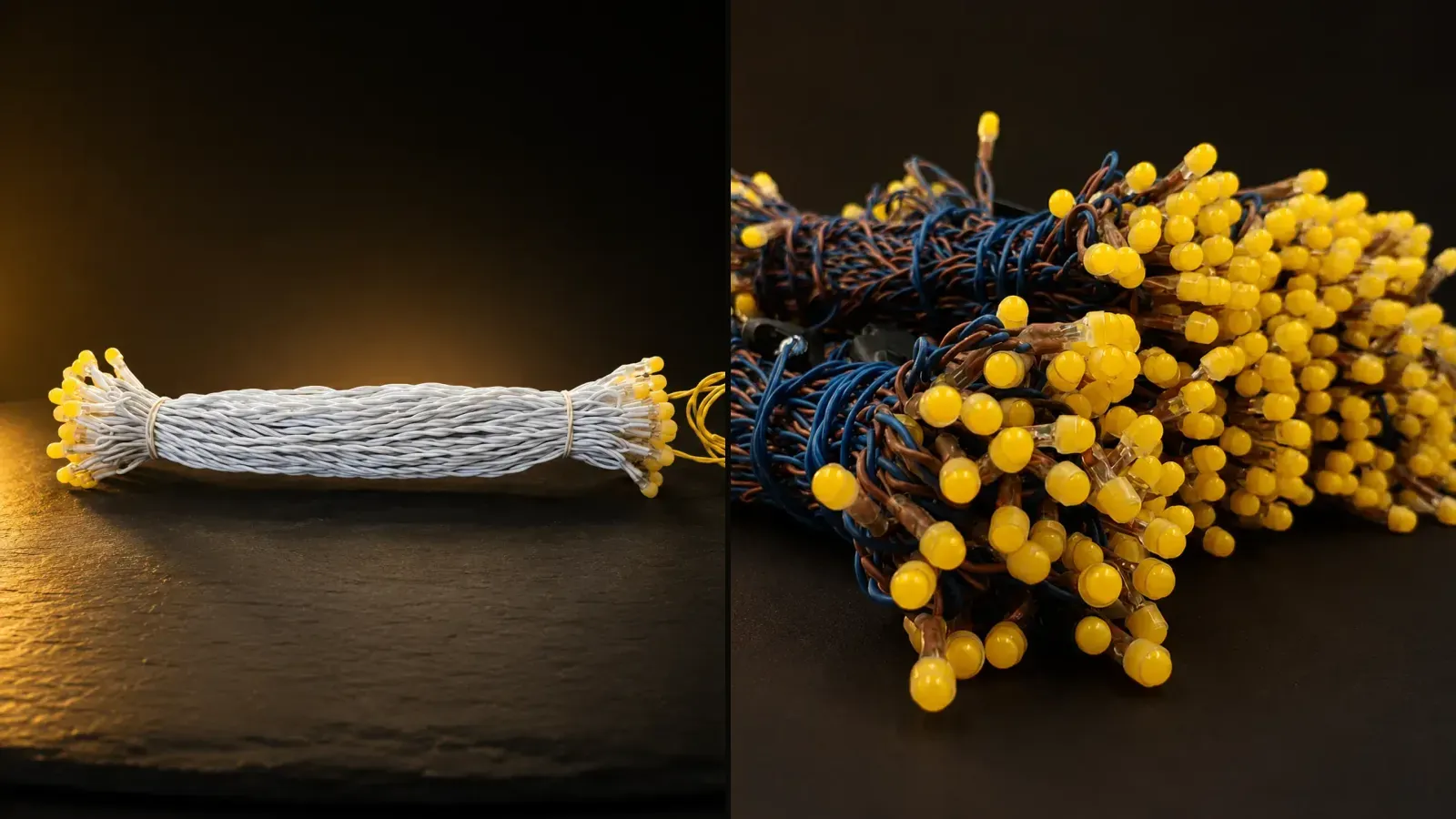
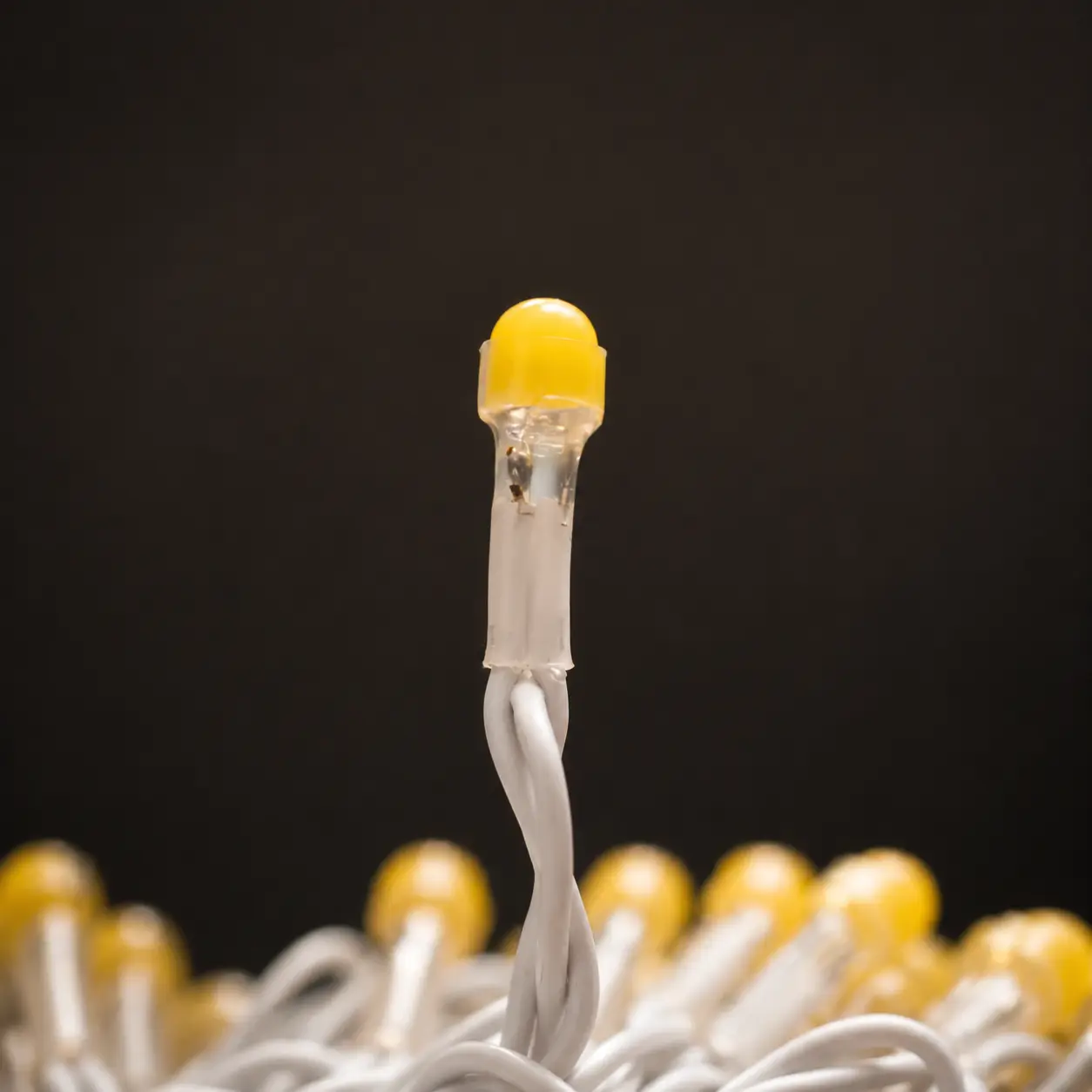
| LED | 2 to 3 mm bare chip, the size of a grain of rice | 5 mm chip under a moulded cap, often coloured |
| Wire | Thin twin wire, bends around anything | Thicker twisted twin wire, holds a shape |
| Spacing | Close, 5 to 8 cm | Wider, 8 to 12 cm |
| Look | A continuous glowing line | Distinct bright points |
| Brightness per LED | Low | Several times higher |
| Brightness per metre | Moderate, from density | High |
| Rating | IP20, indoor only | IP44, covered outdoors |
| Controller | Often none, or a basic one | Inline, eight modes |
| Our price per metre | ₹27 to ₹36 | About ₹37 |
| Best at | Close up: plants, frames, the mandir, glass | Distance: railings, door frames, facades |
The rice light's strength is density. Wound through a plant or along a shelf, thirty LEDs a metre read as one soft line of light, and no other string does that as cheaply. The pixel light's strength is throw. Each capped LED is a small lamp in its own right, and a railing wrapped in them is visible from the far side of the road. The rice light vs pixel light question is really a close-up versus distance question. One thing they share: both are wired in series sections, so one dead LED darkens the section after it on either kind.
Rice light vs fairy lights
In English the two words mean the same thing: a thin wire with tiny lights along it. In an Indian marketplace listing they have drifted apart, and the drift is about voltage rather than looks.
Search for fairy lights and most of what comes back is copper wire micro LEDs on a USB plug or a battery box: 3 to 10 metres, bendable enough to stuff into a bottle, and safe to leave in a child's room because there is no mains voltage anywhere in the string. Search for rice lights and most of what comes back is the 220 V mains string with a plug and a controller, sold in 10, 20, 50 and 100 metre lengths for Diwali.
That matters when you plan a run. A USB fairy light cannot do a balcony railing; it is too dim outdoors and it has nowhere to plug in. A mains rice light cannot go in a bottle on a bedside table; it is IP20 and it is 220 V. If a listing says fairy lights, read the voltage before anything else. If it says rice lights, assume mains. The two kinds of series light connection follow directly from which one you have.
Pixel light vs string lights
String light is the word Western brands and a few Indian ones use, and it covers everything from a rice light to a festoon of bulbs the size of eggs on a rubber cable. If a listing says string lights and shows big round bulbs on a black cable, that is festoon lighting, a different product for a cafe terrace or a wedding lawn, and not a pixel light at all.
There is a second confusion worth clearing. To a professional lighting designer, a pixel is an individually addressable RGB LED, the kind that runs a programmed display on a building or a stage from a controller and software. Those are 5 V or 12 V, sold by the metre or the reel, and need a data signal to do anything. The Diwali pixel light shares the word and nothing else. It is a mains string with a fixed set of modes, and it does not talk to a computer. If someone quotes you a price per pixel for a facade, they mean the other kind.
What is ladi light in English?
String lights. Ladi is Hindi for a row or a garland, so a ladi light is a garland of lights: any long mains string of small LEDs, whether rice or pixel, sold for Diwali, a wedding house, a shop front or a pandal. The word is what an electrician in Delhi, Jaipur or Lucknow will use, and it is why the multi-socket wire that runs many strings from one plug is a ladi jointer. In the south and west, series light is more common for the same thing. On a listing, rice light and pixel light are the specific names, and ladi or series light is the family they both belong to.
Rice light vs pixel light: which to buy where
The names sorted, the question is the one people actually have: which string for which place. This is the table we work from when someone sends a photo.
| Place | Buy | Why |
|---|---|---|
| Balcony railing, under the slab | Pixel light, 15 m | Seen from the street, gets spray, needs IP44 |
| Balcony railing, open to the sky | Neither. IP65 string or a focus light | Direct rain beats IP44 |
| Glazed or enclosed balcony | Rice light | It is a room; density looks best close up |
| Main door frame, outside under a porch | Pixel light | Distance and weather |
| Door frame, inside | Rice light, 10 m | Close up, dry, cheaper |
| Plants and pots | Rice light, 5 m | Thin wire winds through leaves without showing |
| Photo frames, shelves, the mandir | Rice light | Continuous line, no hot spots |
| Window frame from inside | Rice light, 5 m | Dry, close, seen from a few metres |
| Window frame from outside | Pixel light | Seen from the street, splash |
| Facade, parapet, compound wall | Pixel light on a jointer, or a focus light | Throw and rating |
| Bottle, jar, craft | USB fairy light | Low voltage, bendable, no plug |
| Child's bedroom | USB fairy light | No mains voltage in reach |
The rule underneath the table: anything seen from more than about 5 metres away, or anything that gets weather, is a pixel light. Anything seen close up in a dry room is a rice light. Anything a child will touch is a USB string. For the balcony specifically, the Diwali balcony layouts work through the metres for each case.
Brightness, spacing and how each photographs
Rice light vs pixel light on brightness is not the contest it looks like. A rice light has more LEDs per metre and less light per LED. A pixel light has fewer LEDs per metre and far more light per LED. The totals are closer than you would expect, which is why the choice is about where the light is seen from rather than how much of it there is.
Close up, the rice light wins on looks. Thirty small points a metre merge into a line, and the line follows whatever it is wound around: a stem, a frame, the edge of a mirror. A pixel light at the same distance shows as separate bright dots with dark wire between them, which is fine on a railing and fussy on a photo frame.
From across a room or a road, the order flips. The rice light becomes a faint haze. The pixel light stays a crisp row of points, each one bright enough to register on its own, and a railing wrapped in them is legible from three floors down. Phone cameras exaggerate this: they expose for the brightest point in frame, so a pixel railing photographs well from the street while a rice railing photographs as a dim smear. Both come in warm white; the warm white versus cool white choice is the same for both, and warm wins for Diwali either way.
Price per metre: what the difference buys
These are our prices at the time of writing. The per-metre column is the fair comparison, because the strings come in different lengths.
| String | Length | Price | Per metre | Rating |
|---|---|---|---|---|
| Rice Light Series | 5 m | ₹179 | ₹36 | IP20 |
| Rice Light Series | 10 m | ₹299 | ₹30 | IP20 |
| Rice Light Series | 20 m | ₹549 | ₹27 | IP20 |
| Pixel Blinking Series | 15 m | ₹549 | ₹37 | IP44 |
Two things stand out. The rice light gets cheaper per metre as it gets longer, so a 20 metre string is the best value indoors if the run justifies it, and one long string beats two short ones anyway. And the pixel light costs about a quarter more per metre than the 10 metre rice light, which is what the bigger LEDs, the IP44 rating and the eight-mode controller cost. On a railing that is money well spent. On a photo frame it is money spent on a rating you do not need.
Can you mix rice lights and pixel lights?
In different places, yes, and most well-lit homes do: pixel on the railing, rice on the plants below it. In the same line of sight, no, and this is where the rice light vs pixel light difference stops being a preference. The two strings differ in brightness by a large margin and in white point by a small one, and both differences show when they share a wall. The rice light looks dim and slightly off-colour next to the pixel, and the pixel looks harsh next to the rice.
Keep them in separate zones with an edge between them. Railing and plants is fine because the railing is above and the plants are below. Railing and door frame on the same balcony is not, unless both are the same string. And do not run a rice light and a pixel light from the same jointer expecting the modes to match; each has its own controller and they will never agree, which is why the connection guide says to set every string on a jointer to steady.
Common mistakes
- Buying USB fairy lights for a railing. Too dim outdoors, and nowhere to plug in. Fairy in a listing usually means low voltage. Read the volts.
- Buying a rice light for an open railing. It is IP20. It lasts until the first shower. The difference between IP20, IP44 and IP65 is the difference between a light and a fault.
- Buying a pixel light for a photo frame. You pay for a rating and a controller you do not need, and the dots look fussy close up.
- Comparing by LED count. A 100-LED rice light and a 100-LED pixel light are not the same brightness. Compare LED size and rating, then length.
- Expecting a Diwali pixel light to do what a decorator's pixel does. It has eight modes and no data line. Programmed displays are a different product.
- Mixing the two on one wall. Different brightness, slightly different white. Zone them.
- Assuming ladi means a particular string. It means any of them. Ask whether it is rice or pixel, and what the rating is.
The short version
Rice light vs pixel light comes down to distance and weather. A rice light is small LEDs packed close on thin wire, IP20, cheapest per metre, and it belongs anywhere seen close up in a dry room: plants, frames, the mandir, a glazed balcony, a window from inside. A pixel light is big capped LEDs on thicker wire, IP44, with a controller, and it belongs anywhere seen from the street or touched by weather: the railing, the outside of the door, the facade. Fairy light is the English word for the first kind and usually means USB or battery in an Indian listing. Ladi and series light mean any mains string. Choose rice light vs pixel light by where the string will be seen from, keep the two out of one line of sight, and buy the longest single length the run allows. If you send us a photo of the space on WhatsApp we will tell you which of the two, and how many metres.
Common questions
What people ask us about this
- Rice light vs pixel light: which is brighter?
- Pixel light, clearly. Each pixel LED is a 5 mm chip under a moulded cap and puts out several times the light of a 2 to 3 mm rice LED. A 15 metre pixel string reads from the street; a rice light of the same length reads from the room. Rice lights make up for it with density, so close up, on a plant or a frame, they look fuller. From a distance, pixel wins.
- Are rice lights and fairy lights the same thing?
- Nearly. Fairy light is the English name for any thin-wire string of tiny LEDs, and rice light is the Indian name for the same idea, after the grain-sized bulbs. The practical difference is voltage. In Indian listings, fairy lights usually means a USB or battery copper-wire string, while rice lights usually means a 220 V mains string with a plug. Check which one you are buying before you plan a railing around it.
- What is ladi light in English?
- String lights, or series lights. Ladi is the Hindi word for a row or a garland, so a ladi light is a garland of lights: any long mains string of small LEDs sold for Diwali, weddings and shop fronts. A ladi jointer is the multi-socket wire used to run many of them from one plug. Rice lights and pixel lights are both types of ladi.
- Pixel light vs string light: is there a difference?
- In India, a pixel light is a specific type of string light: bigger capped LEDs, usually with a mode controller, usually IP44. String light is the general English term and in the West often means bulb-style festoon lights on a cable. Outside decorative lighting, pixel also means individually addressable RGB LEDs used for programmed displays, which is a different product from the Diwali pixel light entirely.
- Rice light vs pixel light for a Diwali balcony?
- Pixel light for the railing, rice light for anything sheltered. A balcony railing gets spray, needs IP44, and is seen from the street, which is exactly what a pixel light is built for; one 15 metre string does the railing and both sides for ₹549. Rice lights are IP20 and belong on the plants, the door frame inside, or a glazed balcony, where their density looks best close up.
- Can rice lights be left on all night?
- They run cool enough that the LEDs are not the concern; a 10 metre rice light draws about 5 W. The inline controller and the plug are the only parts that warm up, and they are the reason to switch off at bedtime rather than leave a string unattended. If it must stay on, keep the controller indoors and off the floor.
- What is the price of a 10 metre rice light?
- ₹299 for ours, in warm white or cool white, which is about ₹30 a metre. A 5 metre string is ₹179 and a 20 metre string is ₹549, so the price per metre falls as the string gets longer. A 15 metre pixel string is ₹549, about ₹37 a metre, and the difference pays for the bigger LEDs, the IP44 rating and the eight-mode controller.
- What exactly is a pixel light?
- A mains decorative string where each LED is a 5 mm chip sealed under a small moulded cap, often coloured, on a twisted twin wire, with an inline controller that runs steady, fade, chase and twinkle modes. The cap spreads the light so each LED reads as a distinct bright point, which is where the name comes from. Most are IP44, which makes them the standard string for railings and outdoor frames.
From the shop

