
In this guide
- Check 1: the socket and the extension board
- Check 2: the plug and the push-fit connector
- Check 3: the controller, steady mode versus patterns
- Check 4: one dead LED and the half-dark string
- Check 5: damaged wire and water in the joint
- Check 6: when to stop and replace
- Symptom to cause: the quick table
- Series light without plug: how to fit one safely
- New series light not working: dead on arrival
- Common mistakes that finish a string
- The short version
Short answer: a series light not working is usually not the string. About half the faults people bring us are a dead socket or extension board, a plug that has worked loose, a blown fuse in the plug, or one dead LED taking out the section after it. Test the socket, reseat the plug and connectors, switch to steady mode, and look for one dark LED, in that order. If the controller has melted or the MCB trips when you plug in, stop: that string is finished.
Everything below runs on 220 V mains. Unplug the string before you touch any part of it, and nothing on this page involves opening a controller or cutting a wire.
Check 1: the socket and the extension board
Plug a phone charger into the same socket, on the same extension board, before you do anything to the light. A tripped MCB, a switched-off wall socket or a dead extension board looks exactly like a dead string from across the room, and extension boards fail far more often than the strings plugged into them. During Diwali the board behind the balcony curtain is usually carrying three strings, a phone and sometimes a heater, and its switch or its own fuse gives up first.
If the charger does not work either, the fault is upstream of the light. Check the board's own switch and rocker, then the wall socket, then the MCB in the distribution box. If the charger works and the string does not, move to check 2.
Check 2: the plug and the push-fit connector
Unplug the string. Look at the two pins on the plug for black marks or a loose pin that turns in the plug body. Then find the push-fit connector where the controller joins the string, and the second one where the string joins the plug lead if there is one. These are the parts that vibrate apart on a railing in wind and get tugged when a curtain is drawn across them. Push each one firmly home until it clicks, then plug the string back in.
Many strings also hide a small glass fuse inside the plug body, behind a sliding cover or a single screw. It is designed to blow first and protect the string. A blown fuse is the single most common fault on an otherwise healthy light and the replacement costs a few rupees at any electrical shop. Take the old one with you so the rating matches; a bigger fuse defeats the point of having one.
Check 3: the controller, steady mode versus patterns
The inline controller is the small box on the wire, a few centimetres from the plug, with one button on it. On an eight-mode string it drives steady, slow fade, chase, twinkle and the combinations. It is also the only part of the string with electronics in it, which makes it the second most common point of failure after the plug.
The test is simple. Press the button until the string reaches steady mode. If steady works and the patterns do not, or the patterns stutter and steady is clean, the LEDs are fine and the controller is failing. If the string flickers in every mode, go back to check 2, because a loose connector behind the controller flickers exactly like a bad controller.
On strips and RGB runs the controller is a cheap, separately replaceable part. On a 220 V decorative string it is moulded onto the wire, and an LED series light not working because of its controller is replaced as a whole. That is the honest answer, and it is why a string with a six month replacement warranty is worth the extra ₹100 over one with none.
Check 4: one dead LED and the half-dark string
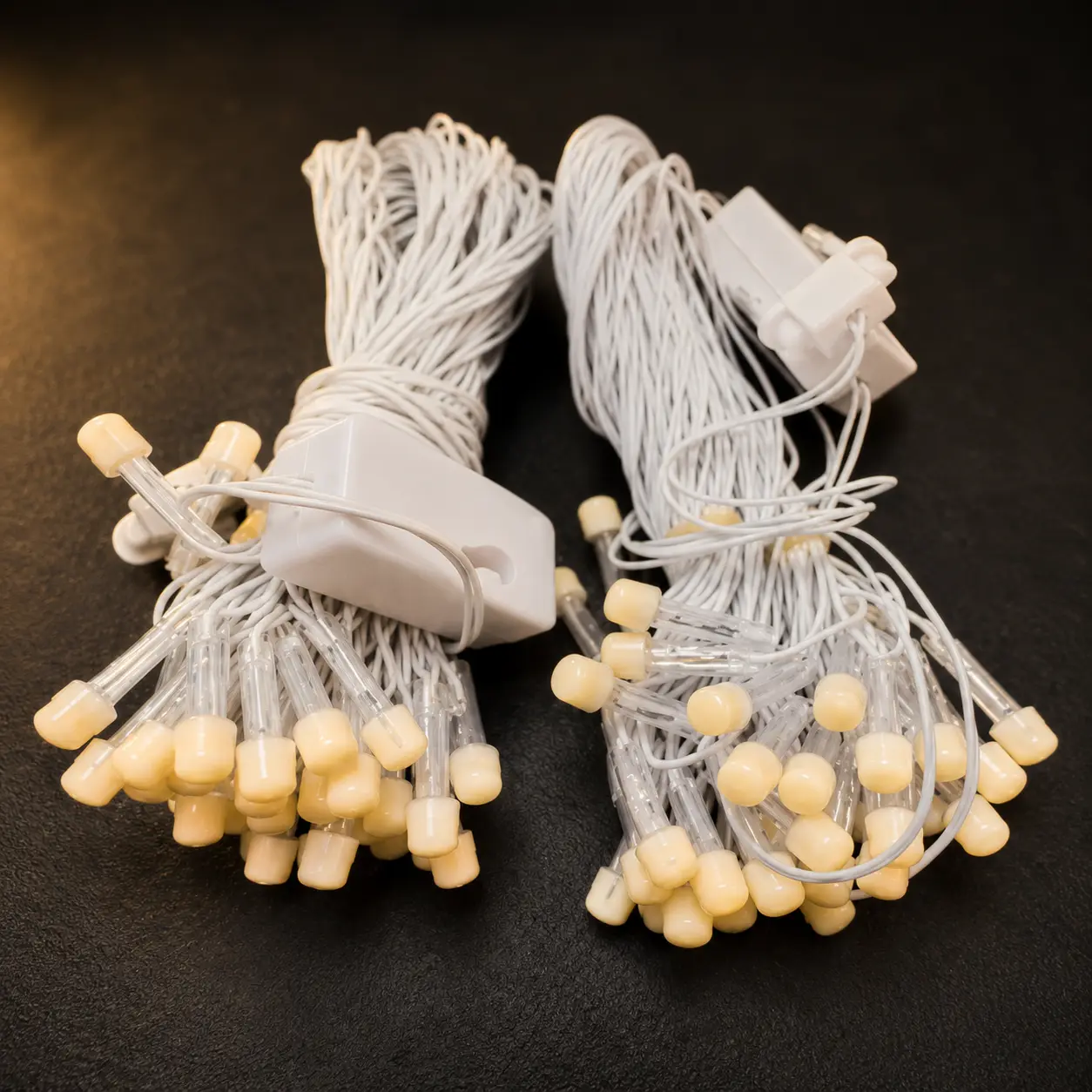
Half the string lit and half dark is the fault people search for most, and it has one cause almost every time. Decorative strings wire their LEDs in series sections of anywhere from ten to fifty LEDs. Current flows through each LED in turn, so one LED that fails open circuit cuts power to every LED after it in that section, while the sections before it stay lit. That is why the dark part starts at a clean line and not at random.
Unplug the string and look along the dark section, starting at the boundary with the lit part. You are looking for one LED that is blackened, cloudy, cracked, or sitting loose in a holder. Older bulb-type strings let you pull that one bulb and push in a spare from the packet; swapping it revives the whole run, as long as the spare is the same warm white or cool white as the rest, or the fix shows. Sealed LED strings, which is most of what is sold now, do not have replaceable LEDs, and the section stays dark.
A half series light not working is still a working string for the lit half, and a lot of people finish the festival with it wrapped so the dark section is behind a plant. That is fine for a week. It is not fine to cut the dark section off: these are 220 V strings, and a cut end is a live wire.
Check 5: damaged wire and water in the joint
Run the whole length through your hands with the string unplugged. You are feeling for a kink where the wire was pinched in a door, a flattened section where it was walked on, a joint where the outer sleeve has split, and any bulge or soft spot that means water has got in. On a string that worked all evening and died after rain, the water is in the controller, the plug or a joint, and it is a real electrical hazard rather than an inconvenience.
Do not dry it out and put it back up on the same run. An indoor IP20 string on an open railing was the wrong product for that position, and the next shower does the same thing with the insulation already weakened. The short version of IP44 vs IP65 is IP44 under a slab, IP65 anywhere the rain reaches, and the controller and plug under cover whatever the LEDs are rated.
Check 6: when to stop and replace
Stop, unplug, and do not plug it in again if any of these is true:
- The insulation is cracked or the copper is visible anywhere along the wire.
- There is browning, bubbling or melting on or around the controller or the plug.
- The MCB trips the moment the string is plugged in.
- The string has been submerged, or water has visibly got inside the controller.
- The string gets warm to the touch along the wire. LEDs run cool; a warm wire is a short.
A decorative string costs a few hundred rupees. Every one of the faults above is a 220 V fault, and no decoration is worth a fire in a flat with the family asleep. Bin it and replace it.
Symptom to cause: the quick table
Match what you see to the most likely cause before you start pulling things apart.
| What you see | Most likely cause | Check |
|---|---|---|
| Whole string dead | Socket, extension board, plug fuse, loose connector | 1 and 2 |
| Half the string dark, clean boundary | One failed LED in a series section | 4 |
| Flickers only on patterns | Controller failing | 3 |
| Flickers in every mode | Loose plug pin or connector, then controller | 2, then 3 |
| One colour missing on a multicolour string | One circuit open, or one controller channel dead | 3, then 4 |
| Modes stuck on one setting | Worn mode button on the controller | 3 |
| Bright at the plug end, dim at the far end | Normal on very long runs; abnormal if new, then a partial short | 5 |
| Worked all evening, died after rain | Water in the controller, plug or a joint | 5, then 6 |
| Trips the MCB | Short circuit, damaged insulation | 6, stop |
| Warm wire | Short circuit | 6, stop |
Series light flickering: what it means by mode
Flickering has three different causes and the mode button separates them. Flickering that appears only when a pattern is selected is the controller's switching wearing out; steady mode bypasses that switching, which is why it stays clean. Flickering in every mode, including steady, is a poor connection somewhere between the wall and the first LED, and it responds to reseating the plug and the push-fit connector. Flickering that comes and goes with the wind, or when the curtain moves, is a broken strand inside the wire that touches and parts as the string moves. That third one cannot be fixed and should be retired, because a strand that arcs inside its insulation is how the insulation eventually fails.
Series light only one colour working
A multicolour string is really two, three or four strings in one sleeve, one circuit per colour group, and the controller switches between them to make the patterns. When one colour is dark along the whole length, either that circuit has an open LED, which is check 4 applied to one colour, or the controller channel that drives it has failed, which is check 3. Steady mode tells them apart. If the missing colour comes back on steady, the controller is on its way out. If it stays dark in every mode, the circuit itself is open and the string is replaced.
Series light without plug: how to fit one safely
Some strings, especially ones bought loose from a wholesale bundle, arrive with two bare wires and no plug. The only safe answer is a proper two-pin plug rated for 220 V. Strip each wire 8 mm, twist the strands, put each one under its terminal screw and tighten until the wire does not pull out, then close the plug body so that no copper shows outside it. A moulded plug from an old, dead appliance lead can be cut off and used the same way if it has screw terminals inside.
What is not acceptable is twisting the bare wires into the holes of a socket, holding them there with matchsticks, or taping them onto the cut end of an extension lead. Every one of those puts live 220 V copper where a child or a wet hand can reach it. If you have never wired a plug, an electrician does it in five minutes.
Joining strings, jointers and adapters are a different question from a plug, and the series light connection guide covers them.
New series light not working: dead on arrival
Every string we send is powered up and run through its modes before it is packed, so a string that is dead out of the box is rare. When it happens, do not open the controller or cut anything, because that ends the warranty. Test the socket with a phone charger, then photograph four things: the string laid out flat, the plug pins, the controller, and the label on the box or the order number. Message those to us on WhatsApp within seven days and the string is replaced without argument.
After seven days the six month replacement warranty takes over. It covers a controller that fails, a section that goes dark, a plug that stops working, anything that is a fault in the product. It does not cover a wire cut in a sliding door, an IP20 string that went out in the rain, or a string that was joined to three others. Those are covered in the next section, because they are the same things that cause a series light not working in the first place.
Common mistakes that finish a string
- Cutting into a 220 V string. Cutting off a dark section, or shortening a string to fit, leaves a live end and usually breaks the series circuit for the rest. Wrap the surplus around a bar instead, or buy the right number of metres so there is no surplus to cut.
- Joining strings that are not rated for it. Plugging one string into the tail of another puts the current for both through the first controller. Unless the product page states a maximum number of joined strings, use separate sockets or an extension board.
- Running the wire through a sliding door track. The door crushes the wire a little more every time it closes, and the fault appears three weeks later as flickering in the wind. Go over the frame or under the fixed pane.
- Indoor string on an open railing. It looks fine for a fortnight and dies in the first shower. Check the IP rating before it goes outside.
- Leaving the controller in the rain. Even on an IP44 string the controller and plug are the parts that must stay dry. Tuck them under the slab or inside the door, which is where every balcony layout we suggest puts them.
- Pulling on the wire to move it. The push-fit connectors are the weakest point; pull them apart in a hurry and the string is dead until someone finds which one let go.
The short version
A series light not working is a five minute job most of the time. Test the socket with a charger, reseat the plug and the push-fit connectors, check the fuse in the plug, switch to steady mode to rule the controller in or out, and look for the one dark LED at the start of a half-dead section. Those six checks account for roughly half of everything we see. If the controller has melted, the insulation is cracked, the wire is warm or the MCB trips, that string is finished and the answer is a new one, not a repair. And if it is a new string that was dead out of the box, photograph it and message us within seven days. Fixing a series light not working should never involve opening a controller, cutting a wire, or plugging bare copper into a socket. If the fault is not in the six checks, it is in the bin.
Common questions
What people ask us about this
- Why is half my series light not working?
- Almost always one failed LED. Decorative strings are wired in series sections, so one open-circuit LED cuts power to every LED after it in that section while the rest of the string stays lit. Unplug the string and look along the dark section for a bulb that is blackened, cloudy or loose in its holder. On strings with replaceable bulbs, swapping that one bulb revives the whole run. On sealed strings the section cannot be repaired.
- Can a series light not working be repaired at home?
- Often, yes, without tools. A dead socket, a loose plug, a push-fit connector that has vibrated apart and a blown fuse in the plug cover all fixable in minutes. What cannot be repaired at home is a melted controller, a sealed LED section with one dead LED, cracked insulation, or a string that trips the MCB. Those get replaced, because every one of them is a 220 V fault.
- Why is my series light flickering?
- Usually the controller rather than the LEDs. If the string is steady on the steady mode and flickers only on the patterns, the controller is failing. If it flickers in every mode, unplug it and check the plug pins and the push-fit connector behind the controller, because a loose connection flickers exactly like a bad controller. A string that flickers only in wind has a broken strand inside the wire and should be retired.
- Why are the modes on my series light not changing?
- The mode button on the inline controller is a small tactile switch and it is the first part to wear. Unplug for ten seconds, plug back in and press once. If the string comes on steady and stays there whatever you press, the controller is worn out. The LEDs are fine, and on a string where the controller is not sold separately the answer is a new string.
- Why is only one colour working on my multicolour series light?
- A multicolour string has two or more circuits, one per colour group, each switched by the controller. One colour dead across the whole length means that circuit has an open LED or a failed channel in the controller. Try steady mode. If the missing colour returns, the controller is failing; if it stays dark in every mode, the fault is in that circuit and the string needs replacing.
- My series light has no plug. How do I connect it?
- Fit a proper moulded or screw-terminal two-pin plug rated for 220 V, with each wire stripped 8 mm, screwed down tight and no bare copper showing outside the plug body. Twisting the wires into a socket, or taping them to a cut extension lead, is how decorative lights start fires. If you have never wired a plug, an electrician does it in five minutes for the price of a cup of tea.
- My new series light is not working out of the box. What do I do?
- Do not open anything. Test the socket with a phone charger, then photograph the string laid out, the plug, the controller and the label on the box, and message us on WhatsApp within seven days. Every string is tested before dispatch, so a dead-on-arrival string is rare, and it is replaced without argument. After seven days the six month replacement warranty covers any fault that is not physical damage or water in an indoor string.
From the shop

