
In this guide
- The four zones of a garba ground
- Navratri light decoration for the mandap and the garbo
- Lighting the dance circle: focus lights, poles and how many watts
- The canopy of strings over the circle
- Entrance gate, compound wall and the name board
- Navratri light decoration at home
- Colours: warm white, multicolour, or the colour of the day
- Power, cost and the connection plan
- Safety for a crowd
- Timeline: from ordering to Diwali
- Common mistakes
- The short version
Short answer: light a society ground in four zones. Warm white rice light around the garbo and the mandap frame. Twelve 15 metre pixel strings from a centre pole out to the boundary poles over the dance circle. One IP65 focus light on each corner pole, 50 W for a small lawn and 100 W for a full ground, aimed across the circle. One string across the entrance and a focus light on the name board. That is Navratri light decoration for a society, and a home garbo needs one 5 metre rice light. Navratri 2026 runs from 11 to 19 October.
The rest of this guide gives the count and the wattage for each zone, the clearance heights that keep a dandiya stick out of the wiring, what nine nights cost to run, the connection plan, and the timeline that gets it up on the first weekend of October and back out for Diwali.
The four zones of a garba ground
Every garba ground, from a society lawn to a rented plot, has the same four parts, and each one wants a different light. Deciding zone by zone is what stops the ground ending up as one giant blinking string.
| Zone | What happens there | The light it wants | Mode |
|---|---|---|---|
| Mandap | The garbo, the deity, the aarti | Warm white rice light, close and dense | Steady |
| Dance circle | Two to three hours of garba, arms up | A canopy of pixel strings overhead, plus even floodlight from the poles | Steady or slow fade |
| Boundary poles | Hold the canopy and the floodlights | IP65 focus lights, aimed inward | Not applicable |
| Entrance and name board | Arrivals, photographs, the road | Pixel string across the gate, focus light on the board | Chase allowed |
Navratri light decoration for the mandap and the garbo
The mandap is the one place where restraint reads as respect. The light here should come from close range, be warm, and not move. A 10 metre warm white rice light around the frame of the mandap, one loose wrap per upright and a straight run across the top, is the whole of it. A second 5 metre string wound around the stand or shelf the garbo sits on lifts the garbo out of the shadow the frame casts.
Three rules. Steady mode only; a chase pattern running behind the deity's photograph looks like a fault and distracts from the aarti. Warm white only; cool white on the mandap turns the marigold grey and the brass flat, which is the warm white versus cool white rule at its strictest. And half a metre between any wire and any flame: the aarti thali, the garbo's own diya, the incense. The string goes on the frame above, the flames stay on the platform below.
Do not point a focus light at the mandap. The rice light is enough at that distance, and a 100 W beam on the deity from across the ground flattens everything and blinds the person doing aarti. If the committee wants the mandap brighter, a second 10 metre rice light on the frame does it without the glare.
Lighting the dance circle: focus lights, poles and how many watts
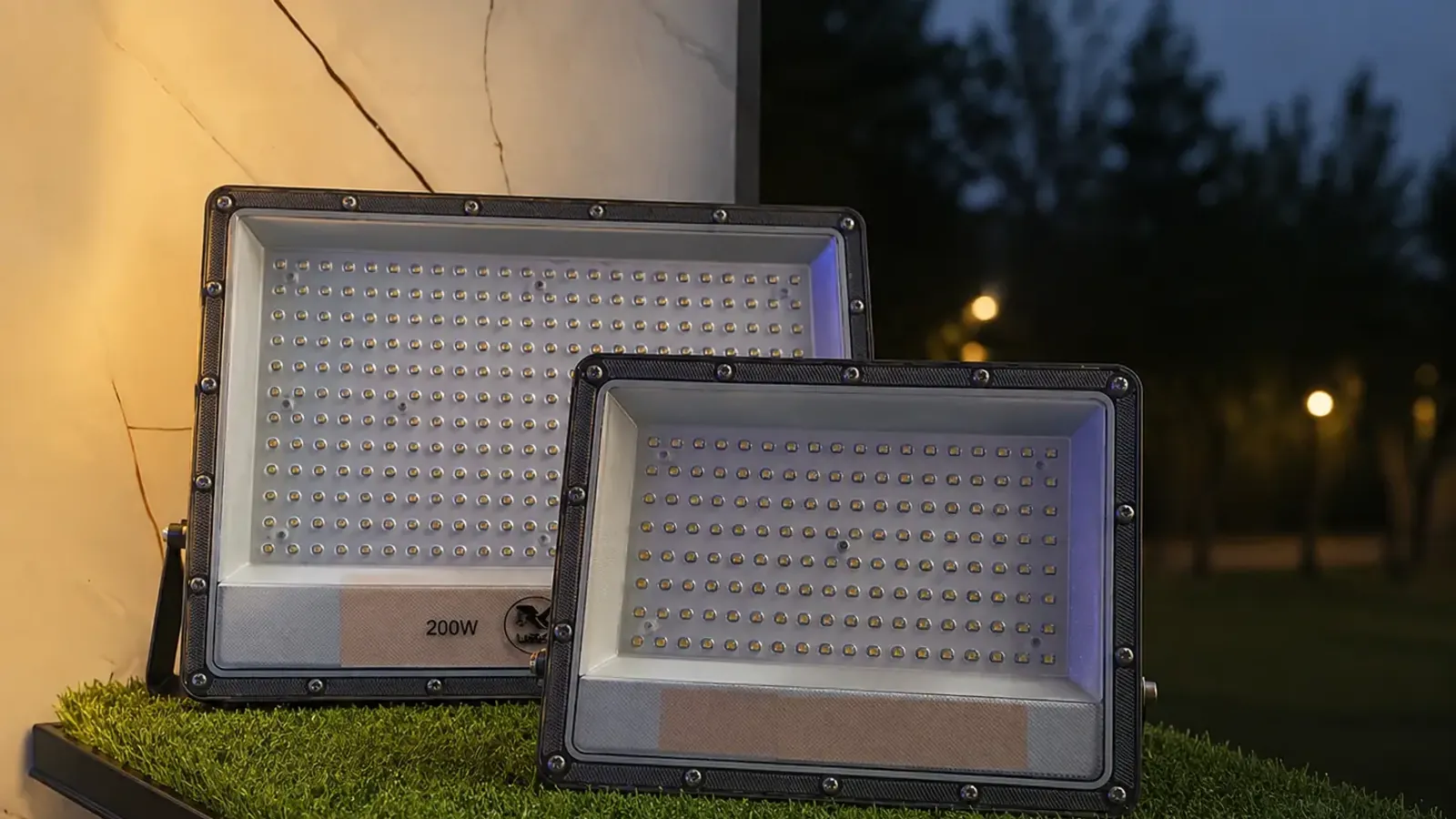
The circle needs two kinds of light: even ambient light so people can see their feet and each other, and the canopy overhead that makes it look like Navratri rather than a car park. The ambient light comes from focus lights on the boundary poles.
A 100 W LED focus light puts out roughly 10,000 lumens. Mounted at 6 to 8 metres and aimed across the circle rather than down, it lights a fan of ground about 25 metres deep to a level that is comfortable for dancing, which needs far less than a sports ground. As a rule of thumb, one 100 W unit per corner covers a ground up to 25 by 25 metres, and larger grounds add units along the long sides; the 20, 50 and 100 W reach figures are worked through in their own guide.
| Ground | Size | Focus lights | Where |
|---|---|---|---|
| Society lawn | Up to 15 × 15 m | 4 × 50 W | One per corner, 5 to 6 m high |
| Standard ground | Up to 25 × 25 m | 4 × 100 W | One per corner, 6 to 8 m high |
| Large ground | 30 × 40 m | 8 × 100 W | Corners plus the middle of each long side |
| Plot with a stage | Any, plus stage | Add 2 × 50 W | Either side of the stage, aimed at the dancers, not the mandap |
Aim every unit inward and slightly down, so the beams cross over the middle of the circle and no one dancing at the edge looks up into a lamp. Aim none of them at the mandap, and none at the road. Cool white is correct here and nowhere else on the ground; the poles are doing the job of a floodlight, and the canopy above supplies the warmth. The 20, 50 and 100 W LED Focus Light is IP65, die-cast aluminium with a toughened glass front and an adjustable bracket, which is what a pole in October weather needs.
The canopy of strings over the circle
This is the part people photograph. Strings run from the top of a centre pole out to the boundary poles like the ribs of a tent with the cloth removed, and the circle underneath is lit from above by hundreds of small points.
The arithmetic is simple. A circle 20 metres across has a radius of 10 metres. A string from the centre pole to a boundary pole, with sag and the drop down the boundary pole to a plug, is 13 to 15 metres. Twelve such lines around the circle, one every 30 degrees, is twelve 15 metre strings, and twelve is the number where the canopy reads as full from underneath. A 30 metre circle wants sixteen to twenty lines and each is a 15 metre string plus a 5 metre extension at the boundary end.
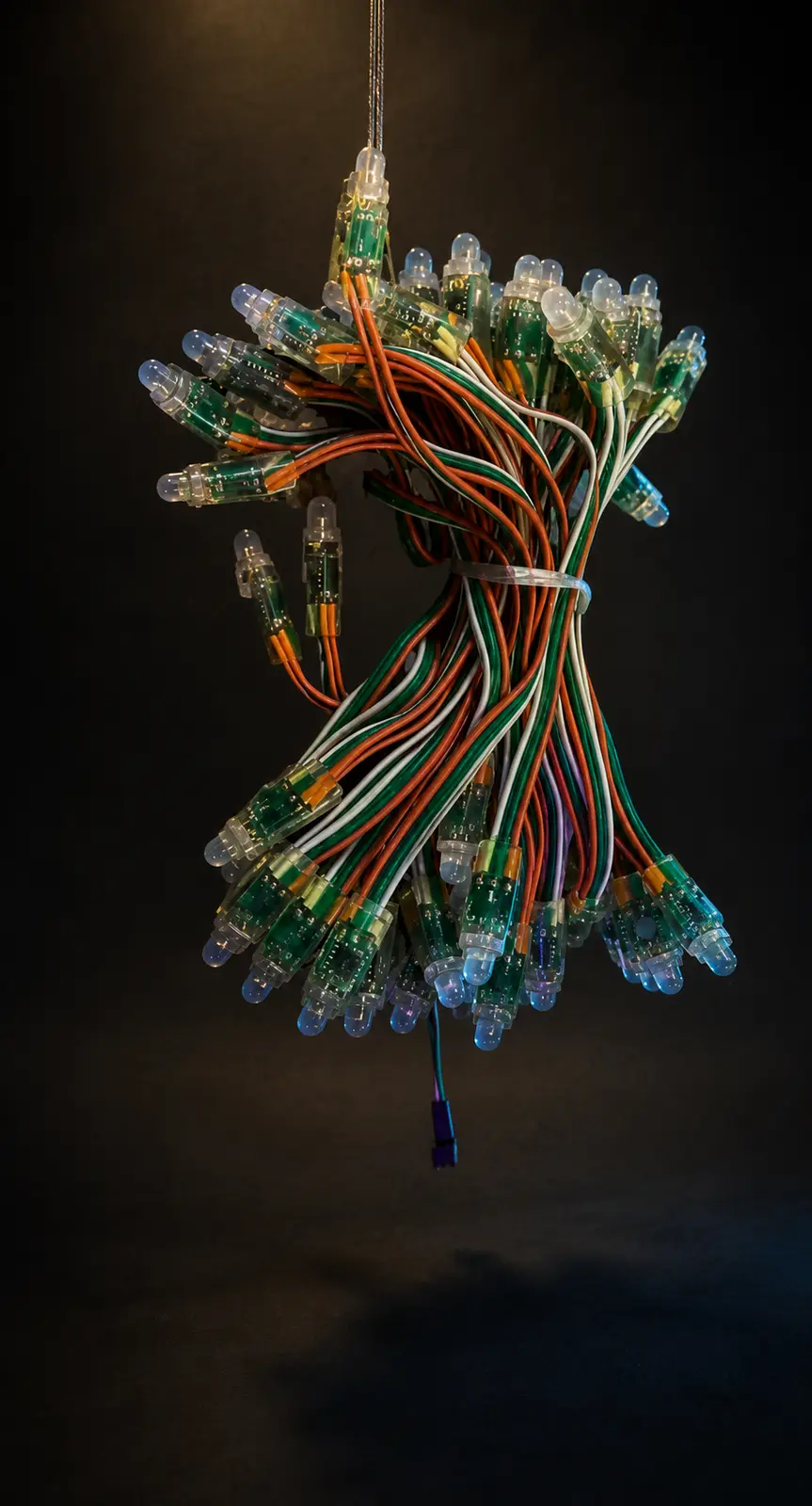
Each line is one Pixel Blinking Series string, warm white, IP44. The pixel string rather than a rice light because the canopy is seen from 6 metres below and from across the ground, which is the distance at which the bigger pixel LED wins and a rice light fades to a haze. Warm white rather than multicolour because the canopy is above every photograph taken all night.
Three rules that matter more than the arithmetic.
Clearance. A raised arm with a dandiya stick reaches about 2.4 metres. The lowest point of any string, which is the sag in the middle of each line, must be at least 3 metres above the ground. That means a centre pole of 5 metres or more and boundary poles of 4 metres, and the strings tensioned enough to keep the sag under a metre, but not so tight that the wire takes the load. A steel wire or nylon rope between the poles carries the weight; the string is tied to that every metre and carries nothing.
Plugs at the boundary. Every string starts at its boundary pole, runs inward to the centre pole, and is tied off there. The plug end, the controller and the connection all sit at the boundary under a small cover, never at the top of the centre pole where nobody can reach a fault. Twelve strings at twelve boundary poles is a job for a ladi jointer run around the boundary or for two or three extension boards; the series light connection guide has the load table, and twelve pixel strings together draw under 120 W.
Steady or slow fade. Twelve controllers will never run a chase pattern in step, and twelve strings chasing out of sync over people's heads for three hours is fatiguing. Set every string to steady, or every string to slow fade, on the first night and leave them.
Entrance gate, compound wall and the name board
The entrance is where the rules of Navratri light decoration relax. It is seen from the road, photographed on the way in, and nobody stands under it for three hours. One 15 metre pixel string across the top of the gate and down both sides, in multicolour if the committee wants colour anywhere, on chase mode if they want movement anywhere. This is the one place on the ground where both are right.
The society name board or the Navratri banner gets its own 20 W focus light from below or from the side, so it can be read from the road and appears in the photographs. A compound wall along the road takes a pixel string per 12 to 15 metres of wall, on a jointer, fixed at the top of the wall with the plugs on the inside face under cover. An open compound wall sees rain, so the wall run is the place to check the difference between IP44 and IP65 before anything goes up; the strings sit under the coping if there is one, and the focus lights are IP65 regardless.
Navratri light decoration at home
At home, Navratri light decoration scales down to two strings and one rule.
The garbo, on its shelf or stand, gets a 5 metre warm white rice light wound loosely around the stand and the shelf edge, on steady mode, plugged into the nearest socket. It is IP20, indoors, and the cheapest string sold is exactly right. Keep the wire half a metre from the garbo's diya, never draped over the opening, and switch it off with the room at night.
The mandir or the corner where the family does aarti gets the same treatment, or shares the same 5 metres if the garbo sits in the mandir. The doorway, if you want the house to say Navratri from the corridor, gets a 10 metre rice light up one side, across the top and down the other, exactly as it would for Diwali three weeks later.
A balcony that faces the society ground can join in. One 15 metre pixel string on the railing, in warm white to match the canopy, and the balcony layouts cover the metres, the rating and the plug position. A society where a dozen balconies do this reads as one lit building from the ground, and it costs each household ₹549.
Colours: warm white, multicolour, or the colour of the day
Every year someone proposes lighting the ground in the colour of the day, nine colours over nine nights. The nine colours are for clothes. Changing the lighting means nine evenings up a ladder and nine chances for a string to come down mid-garba, and coloured light on coloured clothes cancels the point of both.
Warm white on the mandap and the canopy is right every night. It flatters every colour of chaniya choli and kediyu, it photographs the way Navratri looks in memory, and it needs no attention after the first night. Colour lives at the entrance, where a multicolour pixel string carries the festival mood on all nine nights without pretending to follow the calendar. If a committee wants a nod to the day's colour, a coloured dupatta on the mandap frame under the warm light does it in thirty seconds.
Power, cost and the connection plan
Nine nights sounds expensive and is not. Add it up for a standard ground.
| Load | Units | Watts | Four hours a night, nine nights |
|---|---|---|---|
| Focus lights, corners | 4 × 100 W | 400 W | 14.4 units |
| Focus lights, stage and board | 2 × 50 W + 1 × 20 W | 120 W | 4.3 units |
| Canopy strings | 12 × under 10 W | 120 W | 4.3 units |
| Mandap and gate strings | 3 × under 10 W | 30 W | 1.1 units |
| Total | Under 700 W | About 24 units |
At a society tariff of ₹8 to ₹10 a unit that is under ₹250 for the whole festival. The sound system draws more in one night.
The connection plan follows from the zones. The focus lights are fixed fittings and their tails go into gasketed junction boxes on the poles, wired by an electrician to a circuit with an RCD. The canopy strings run to a jointer or boards around the boundary. The mandap strings run to a board behind the mandap. The gate string runs to a socket at the gate. Four zones, four switches, and the committee member on duty can turn the ground off in a minute at the end of the night without walking the perimeter.
Safety for a crowd
A garba ground has a few hundred people, raised arms, sticks, children underfoot and an aarti with open flame, for nine nights running. Four things cover most of it.
Height. Nothing electrical below 3 metres inside the circle. Strings at 3 metres minimum at their lowest sag, focus lights at 5 metres and above, and no cable crossing the dance floor at ground level. A cable that must cross the ground goes overhead on the canopy wire or under a rubber cable ramp taped at both edges.
Water. Poles, wall runs and anything open to the sky at IP65. Canopy strings at IP44 minimum with every controller and plug at the boundary under a cover. Everything outdoors on an RCD-protected circuit, and the ground switched off from the boards rather than by pulling plugs in the dark.
Fire. Half a metre between any wire and any flame, on the mandap and at the aarti. No string draped over the havan kund or the diya stand. The rice light around the garbo goes on the stand below the rim, never across the mouth.
Load discipline. The lighting boards carry lighting. The chai stall, the sound system and the phone chargers get their own sockets. A board that was fine with twelve strings melts with one kettle added, and it happens at 11 pm on Ashtami.
Timeline: from ordering to Diwali
Navratri 2026 begins on Sunday 11 October and ends on Monday 19 October, with Dussehra on Tuesday 20 October. Working backwards from that:
- By 25 September: walk the ground, count poles, measure the circle, decide the zones. Photograph it and send it to us if you want the count checked.
- By 1 October: order. Focus lights, pixel strings, rice lights, a jointer, cable ties, rope for the canopy wire. Couriers are slower in the week before a festival and the 100 W units go first.
- 3 and 4 October: put it up. Poles and focus lights on the Saturday with the electrician, canopy and strings on the Sunday, test every string on the ground before it goes up the pole. A week in hand for a replacement if something arrives faulty.
- 10 October: full test at night, aim the focus lights with people standing in the circle, set every string's mode, label the four switches.
- 20 October: take it down onto cardboard, not into a bag. Focus lights come off the poles with their brackets.
- 31 October and 1 November: it all goes back up for Diwali, which is 8 November. Focus lights to the gate and the facade, pixel strings to the balconies and the compound wall, rice light to the mandir.
The whole Navratri light decoration for a standard ground, bought once, does Navratri, Diwali and the society's New Year, and most of it is still working the following October.
Common mistakes
- Chase mode over the circle. Twelve controllers out of sync for three hours a night. Steady or slow fade on the canopy, chase at the gate only.
- A focus light on the mandap. Flattens the deity and blinds the aarti. Rice light on the frame does it better.
- Strings too low. A dandiya stick at full stretch reaches 2.4 metres. Anything under 3 metres will be hit.
- The string carrying its own weight. A steel wire or rope takes the load between poles; the string is tied to it. A string under tension pulls its joints apart on the first windy night.
- Plugs at the top of the centre pole. Every plug and controller at the boundary, at reach height, under cover.
- The kettle on the lighting board. Lighting boards carry lighting. Everything else gets its own socket.
- Ordering in the second week of October. The 100 W units and the 15 metre strings go first. Order by 1 October.
- Nine colours for nine nights. Warm white every night. Colour at the gate. The dupatta on the frame if you must.
The short version
Navratri light decoration for a society ground is four zones and four kinds of light. Warm white rice light around the garbo and the mandap frame on steady mode. Twelve 15 metre warm white pixel strings from a centre pole to the boundary over the circle, 3 metres clear above raised arms, on a rope that carries the weight, with every plug at the edge. One IP65 focus light per corner pole, 50 W for a lawn and 100 W for a ground, aimed across the circle and never at the mandap. A multicolour string across the gate and a 20 W on the name board. Under 700 W in total, about 24 units for nine nights, four switches. At home it is one 5 metre rice light around the garbo, half a metre from the diya. Order by 1 October, put it up on the weekend of the 3rd, and take it down onto cardboard on the 20th because Diwali is three weeks later. For the count on your own ground, send us a photo on WhatsApp; we are in Surat, and we have stood on a few of them.
Common questions
What people ask us about this
- What are good Navratri light decoration ideas for a society?
- Work in four zones. Warm white rice light around the garbo and the mandap frame on steady mode. Twelve pixel strings from a centre pole out to the boundary over the dance circle, like a tent without the cloth. One focus light on each corner pole aimed across the circle so the ground is lit without anyone dancing into a beam. One string across the entrance gate, where chase mode is welcome, and a focus light on the society name board.
- How many focus lights does a garba ground need?
- As a rule of thumb, one 100 W LED focus light per corner covers a ground up to about 25 by 25 metres for garba, which needs even ambient light rather than sports brightness. A small society lawn of 15 by 15 metres does with four 50 W units. A large ground of 30 by 40 metres wants eight 100 W units, two per side, on poles 6 to 8 metres high, all aimed inward and slightly down.
- Which lights for the garbo at home?
- A 5 metre warm white rice light wound loosely around the shelf or stand the garbo sits on, on steady mode, plugged into the nearest socket. Keep the wire at least half a metre from the diya and never over the garbo's own flame. It is IP20 and indoors, so the cheapest string is the right one, and the same 5 metres frames the mandir for Diwali three weeks later.
- Is Navratri light decoration safe outdoors in October?
- Only with the right rating. The monsoon has withdrawn from Gujarat and most of India by mid-October, but a nine-night ground stays up through any stray shower, so anything on a pole or a boundary needs IP65 and the strings over the circle should be IP44 at minimum with their controllers and plugs at the boundary under cover. Everything outdoors runs from a circuit with an RCD.
- Should Navratri lights follow the colour of the day?
- The nine colours are for clothes, and trying to change the lighting each night means nine evenings on a ladder. Warm white for the mandap and the canopy is right on every night and flatters every colour of chaniya choli. If you want colour, a multicolour pixel string across the entrance gate reads festive all nine nights and changes nothing.
- What does it cost to run the lights for nine nights?
- Less than the chai. Eight 100 W focus lights are 800 W, and twelve pixel strings add under 120 W, so under 1 kW in total. Four hours a night for nine nights is about 33 units, which is ₹250 to ₹350 at a society tariff. A single ground-mounted metal halide of the old kind used more on its own.
- Where can I get Navratri light decoration in Surat?
- We are in Surat and ship from here, so orders within Gujarat arrive fastest. Everything in this guide is on the site: the focus lights in 20, 50 and 100 W, the 15 metre IP44 pixel strings, and the rice lights, with free delivery above ₹999. Send a photo of the ground on WhatsApp and we will tell you the count for each zone.
- Can the same lights be used for Diwali after Navratri?
- That is the plan. Navratri ends on 19 October and Diwali is 8 November, so the focus lights move from the poles to the gate and the facade, the pixel strings move from the canopy to the balconies, and the rice light goes from the garbo to the mandir. Wind each string onto a piece of cardboard when it comes down and nothing tangles.
From the shop
What this guide points you at
 31% OFF
LED Focus Light
Die-cast aluminium floodlight, fully weatherproof
 31% OFF
Pixel Blinking Series
Eight chase patterns with an inline controller
 40% OFF
Rice Light Series
Fine copper wire studded with warm-white LEDs