
In this guide
- Focus light vs flood light: one fitting, two names
- Watts, lumens and how far the light reaches
- How many watts for an outdoor focus light, place by place
- The 20 W: name boards, doors and small gardens
- The 50 W: gates, driveways and shop fronts
- The 100 W: compound walls, facades and grounds
- Cool white on the wall, warm white on the string
- LED focus light for decoration: facades, grounds and wedding houses
- Mounting, wiring and the junction box
- What it costs to run
- LED focus light price: what ₹549 to ₹1,899 buys
- Common mistakes
- The short version
Short answer: an LED focus light of 20 W lights a spot, 50 W lights a gate or a shop front, and 100 W lights a wall run or a ground. From a 3 metre bracket a 20 W covers about 6 metres of ground; from a 5 metre pole a 50 W covers about 9; from an 8 metre pole a 100 W covers about 13. Focus light and flood light are the same fitting. Buy on lumens, IP65 and a die-cast body, and most houses need one 50 W and one or two 20 W, not a 100.
The rest of this guide is the reach of each wattage, a place-by-place table, how to mount and wire one, what it costs to run, what the price buys, and the mistakes that end with a 100 W lighting the neighbour's bedroom.
Focus light vs flood light: one fitting, two names
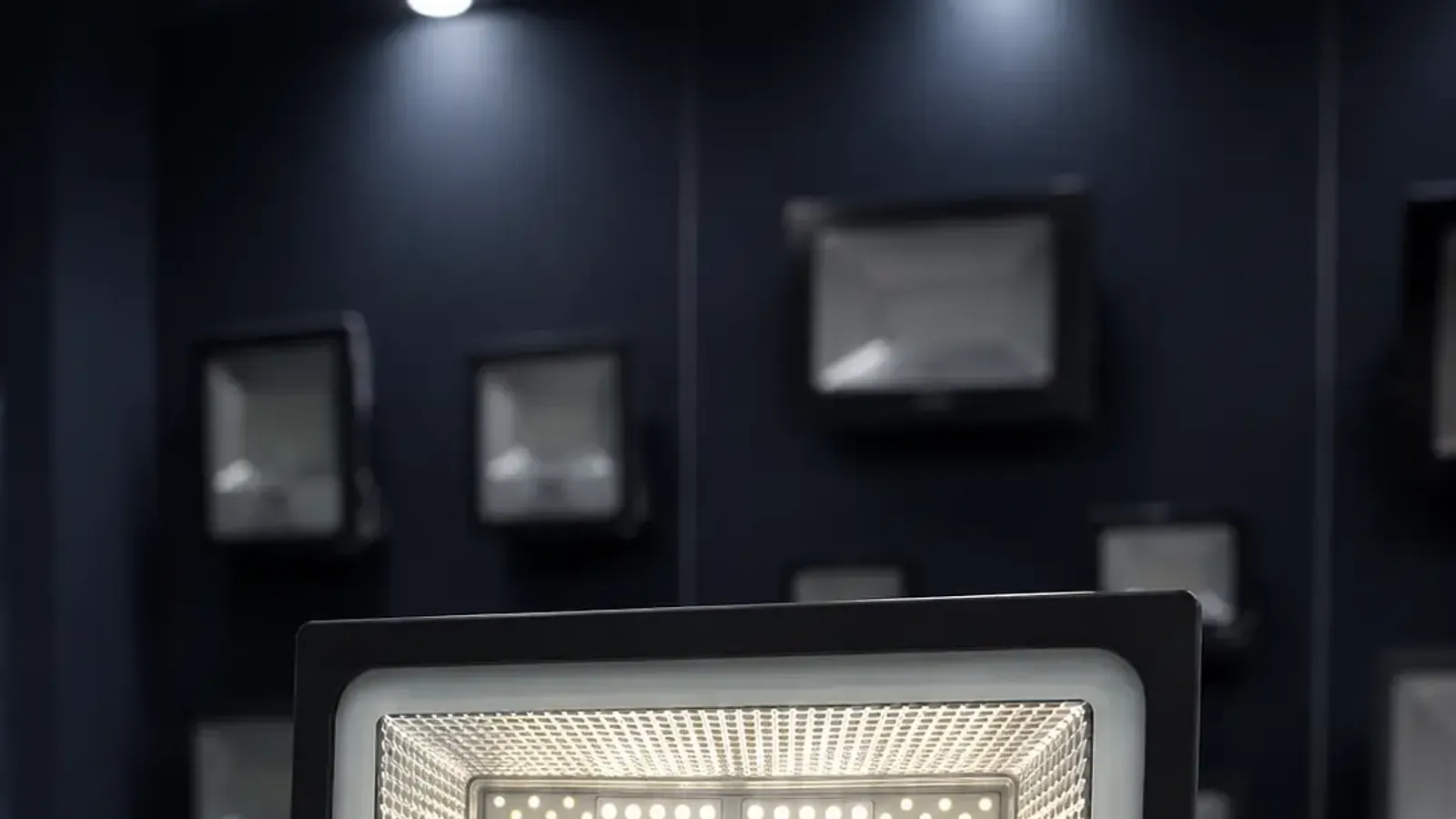
In India the fitting is called a focus light on the street and in the shop, and a flood light in the catalogue and the electrical trade. They are the same object: a flat die-cast aluminium housing, a glass front over an array of LEDs, an adjustable bracket, and a wide beam of 100 to 120 degrees that lights an area rather than a point. Focus light vs flood light is a vocabulary question, not a product one.
The fitting that is different is the spotlight, which throws a narrow beam of 10 to 40 degrees to pick out one object, a statue, a signboard, a tree. Spotlights are what a shop uses on a mannequin. For a gate, a wall, a driveway or a ground you want the wide beam, which is the LED focus light this guide is about.
Watts, lumens and how far the light reaches
Watts measure what the fitting draws. Lumens measure what it gives out, and that is the number that decides how much ground you light. A decent LED focus light produces 80 to 100 lumens per watt, so the three common sizes come out roughly like this.
| Fitting | Lumens, roughly | Mount at | Ground lit to a comfortable level | Reads a face at |
|---|---|---|---|---|
| 20 W | 1,600–2,000 lm | 3 m | 25–30 m², about 6 m across | 4–5 m |
| 50 W | 4,000–5,000 lm | 4–5 m | 60–75 m², about 9 m across | 8 m |
| 100 W | 8,000–10,000 lm | 6–8 m | 120–150 m², about 13 m across | 12–15 m |
Two things follow. Doubling the watts does not double the useful reach, because the light spreads over a larger area as it goes further; a 100 W at 8 metres is softer on the ground directly below it than a 50 W at 4 metres. And mounting height does as much as wattage. The same 50 W at 3 metres is a harsh pool with dark edges, and at 5 metres it is an even wash. The rule of thumb is a mounting height in metres of roughly the tens of watts, capped at 8: a 20 W at 3 metres, a 50 W at 5, a 100 W at 8.
The figures assume a fitting tilted 30 to 45 degrees down toward what it lights. A focus light pointed straight out lights the sky, the road and the house opposite, and almost nothing you paid for.
How many watts for an outdoor focus light, place by place
This is the table we answer WhatsApp photos from. It assumes a comfortable outdoor level, enough to see faces, steps and a number plate, not a floodlit ground.
| Where | Buy | How many | Mounted where |
|---|---|---|---|
| Name board, house number | 20 W | 1 | On the wall above or beside it, 1 m away, aimed at the board |
| Main door and porch | 20 W | 1 | Under the porch slab or on the wall at 3 m |
| Staircase, side passage | 20 W | 1 per 8 m | On the wall at 3 m, aimed along the passage |
| Small garden bed, a tree | 20 W | 1 | On a spike or a low wall, aimed up into the foliage |
| Gate and driveway | 50 W | 1 | On the gate pillar or the wall at 4 to 5 m, aimed down the drive |
| Front of a two-floor house | 50 W | 1 or 2 | On the compound wall, 3 to 5 m back, aimed up the face |
| Shop front, one shutter | 50 W | 1 | Above the shutter line at 4 m, aimed down and out |
| Shop front, three shutters | 50 W | 2 or 3 | One per shutter and a half |
| Compound wall | 100 W | 1 per 15 m | On the wall at 6 m or on a pole, aimed along the wall |
| Three-floor facade | 100 W | 1 or 2 | From the compound wall or a pole, 5 to 8 m back |
| Parking, 8 to 10 cars | 100 W | 2 | On poles at 6 to 8 m, diagonally opposite |
| Garba ground, society lawn | 50 W | 4 | One per corner, 5 to 6 m |
| Garba ground, standard | 100 W | 4 | One per corner, 6 to 8 m |
| Balcony facade wash at Diwali | 20 W | 1 | On the parapet, aimed up the wall above the balcony |
The pattern: 20 W is a spot, 50 W is a gate or a front, 100 W is a run or an area. An independent house that buys one of each has covered the name board, the gate and the facade. A flat has a use for exactly one 20 W, on the parapet at Diwali, and the balcony layouts show where it sits.
The 20 W: name boards, doors and small gardens
The 20 W is the LED focus light people underestimate. At 1,600 to 2,000 lumens it is about the output of a 150 W halogen and more than a 100 W bulb, and because it is small, the housing on ours is under half a kilo, it mounts where a bigger unit cannot: under a porch slab, beside a name board, on a spike in a planter, on a balcony parapet.
It is the right unit for anything within 5 metres. A name board 1 metre from it is legible from the road. A main door under a 20 W is bright enough to find the key and see who is standing there. A tree lit from below by a 20 W becomes the one thing in the garden anyone notices after dark. At Diwali, one 20 W on the parapet aimed up the wall washes two floors of facade above a balcony and makes the flat read from the street in a way no string on the railing can.
The 50 W: gates, driveways and shop fronts
The 50 W is the one most houses buy one of, and if you are only buying one focus light, this is almost always it. Mounted at 4 to 5 metres on the gate pillar or the compound wall and tilted down the driveway, it lights the gate, the car, the person at the gate and the first 8 metres of drive to a level where a face is recognisable. That is the whole of what security lighting at a house needs to do, and from the road it does more than 30 metres of string along the same wall.
It is also the shop front light. Above the shutter line at about 4 metres, aimed down and slightly out, one 50 W per shutter and a half lights the pavement, the signboard's surroundings and the display through the glass. Three shutters is two or three units. For a shop it is worth pairing with a 20 W on the signboard itself, so the sign is brighter than the wall around it.
For the front of a two-floor house at Diwali or a wedding, two 50 W units from the compound wall aimed up the face give a more even wash than one 100 W. The 100 W from one point leaves the far corners dark and the centre hot; two 50 W from two points overlap in the middle and reach both corners.
The 100 W: compound walls, facades and grounds
The 100 W is for runs and areas. A compound wall takes one per 15 metres, mounted on the wall at 6 metres or on a pole, aimed along the wall rather than out from it, so the beam grazes the surface and the whole run is lit rather than one bright patch. A three-floor facade takes one or two from 5 to 8 metres back. A parking area for eight to ten cars takes two on poles, diagonally opposite so no car is in the shadow of another.
And it is the garba ground light. One 100 W per corner pole at 6 to 8 metres covers a standard society ground of 25 by 25 metres to a level that is right for garba, which needs even ambient light rather than sports brightness; the Navratri guide has the ground sizes and pole counts. The same four units move to the gate, the wall and the facade three weeks later for Diwali.
What the 100 W is not for is a house gate. At 3 metres on a pillar it lights the road, dazzles anyone walking up, and the house opposite gets it through the curtains. If a gate feels dark under a 50 W, the answer is mounting it higher or adding a 20 W at the door, not stepping up to 100.
Cool white on the wall, warm white on the string
An LED focus light is cool white, ours at 6500K, and that is correct for what it does. Cool white shows edges, reads a number plate and a face at distance, and makes a wall look clean and sharp. On a gate, a driveway, a wall or a ground it is the right colour, and warm white in those places looks dim for the same lumens.
Where cool white is wrong is anywhere people sit or anything festive at close range: a balcony railing, a door frame, the mandap at Navratri, a dining terrace. Those get warm white strings. The two live together happily as long as they are not on the same surface: a cool wash on the facade above a warm string on the railing is how most well-lit buildings look at Diwali, and the warm white versus cool white guide covers the rule in full. What does not work is a cool focus light aimed at the same wall a warm string is fixed to, or a focus light of any colour aimed at a deity.
LED focus light for decoration: facades, grounds and wedding houses
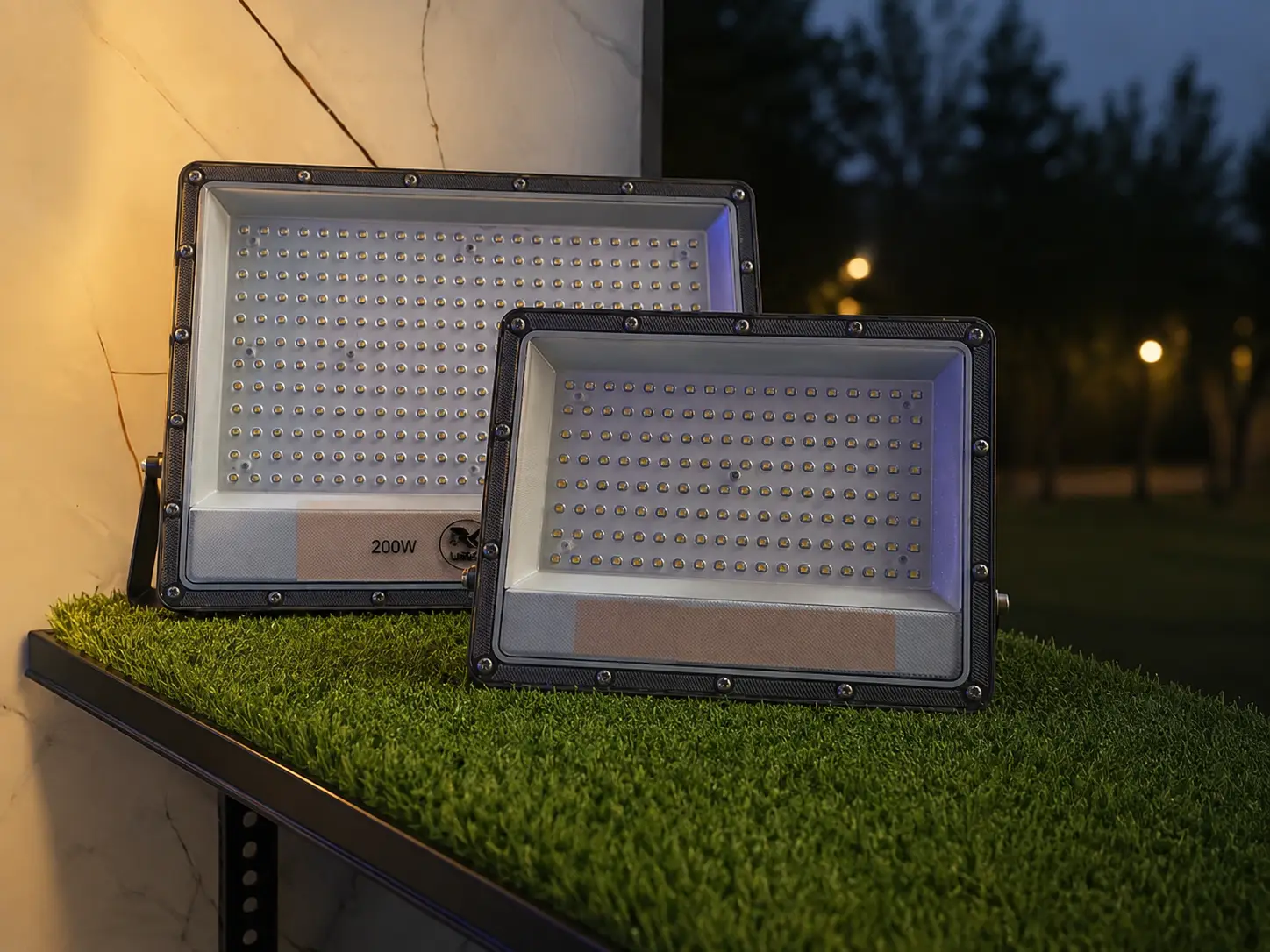
Beyond security, the LED focus light for decoration is the tool for making a building register from a distance, and it does it in three ways.
The upward wash. A unit on the ground or a parapet, 1 to 2 metres out from the wall, aimed up the face at 60 to 70 degrees. The light grazes the wall and picks out every texture, and the building glows from the street. A 20 W does two floors, a 50 W does three or four. This is the Diwali facade trick, and it costs less than a third string.
The gate approach. A 50 W at the gate, aimed down the drive toward the house, lights the path guests walk in on and the photographs taken at the gate. For a wedding house, a second 50 W from the gate aimed at the front of the house completes it.
The ground. Four 100 W units on corner poles for garba, and the same four for the society's Diwali night or New Year function. A pixel string canopy above supplies the warmth; the focus lights supply the visibility.
For all three, aim the fitting at a surface, a wall, a drive, the ground, and never at the road or a window. Decorative light that lands on someone else's property is the fastest way to get the decoration switched off.
Mounting, wiring and the junction box
A focus light is a fixed fitting, not a plug-in string, and the few rules of mounting it are the difference between a light that lasts ten years and one that fails in the first monsoon.
- Height and tilt. Mount at the height for the wattage, 3, 5 or 8 metres, and tilt 30 to 45 degrees down toward what you are lighting. The adjustable yoke bracket on the housing is for this; set it once, tighten the side bolts, and it stays.
- Aim at a surface. The ground, the wall, the driveway. Never at the road, a window, or a person's eye line at a gate.
- Cable gland facing down. The point where the tail enters the housing is sealed by a gland; mounted with the gland at the bottom, water runs off it. Mounted sideways or upward, it collects.
- A gasketed junction box. The light is IP65; the joint you make between its tail and the house wiring is only as protected as the box you make it in. A weatherproof junction box with a rubber gasket, screwed to the wall with the cable entry at the bottom, costs under ₹100 and is where the IP44 versus IP65 distinction actually gets decided.
- An RCD on the circuit. Anything outdoors on 220 V should be on a circuit protected by an RCD or RCCB, the device that trips on current leaking to earth. Most flats and houses built after 2010 have one on the main board.
- An electrician for the fixed wiring. A focus light is wired into the house, not plugged in. Ten minutes of an electrician's time, and the switch ends up where you want it, inside the door.
What it costs to run
The old objection to leaving the gate light on all night was the bill, and with LED it no longer applies.
| Fitting | Six hours a night | Per month | At ₹8 a unit |
|---|---|---|---|
| 20 W | 0.12 units | 3.6 units | About ₹30 |
| 50 W | 0.30 units | 9 units | About ₹75 |
| 100 W | 0.60 units | 18 units | About ₹145 |
| Old 150 W halogen | 0.90 units | 27 units | About ₹215, for less light than the 20 W |
A 50 W LED focus light on from dusk to midnight every night of the year costs less than a takeaway a month. Running cost is never the reason to buy a smaller unit; the reason is glare and where the light lands.
LED focus light price: what ₹549 to ₹1,899 buys
The LED focus light price spread on a marketplace is wide, and the cheap end is cheap for reasons that show up within a year.
The body. Die-cast aluminium is a heat sink; the LEDs run cooler and hold their brightness. A plastic or thin pressed-steel body runs the LEDs hot, and hot LEDs dim to half output within a year or two. Weight is a fair proxy: our 20 W is about 480 grams, the 50 W about a kilo, the 100 W about 1.6 kilos.
The glass. Toughened glass takes a cricket ball, a hailstone and a decade of sun. Polycarbonate yellows and crazes in two summers of Indian UV, and the light goes brown and dim behind it.
The driver. The small circuit board inside that converts 220 V to what the LEDs need is the part that fails on cheap units. A good driver is why a fitting carries a twelve month replacement warranty and a cheap one carries none.
The rating. IP65 printed on the body, not typed into a listing. A fitting that has been tested says so where you can see it.
At ₹549, ₹999 and ₹1,899 for the three sizes, with all four of those things, the LED Focus Light is priced at what a fitting that lasts costs. The 200 W and 240 W units in the same style exist for stadiums, yards and large grounds; a house has no use for one, and a 200 W at 3 metres on a gate is a searchlight.
Common mistakes
- Buying by watts alone. Lumens, body, glass, driver and rating decide whether it is still bright in three years. Watts only decide the bill.
- A 100 W on a house gate. Glare, a lit road, an annoyed neighbour. 50 W at 5 metres.
- Mounting too low. A 50 W at 2.5 metres is a harsh pool with dark edges. Go up to 5.
- Pointing it straight out. Tilt 30 to 45 degrees down. Light the ground, not the sky.
- A plastic body to save ₹300. It dims to half in a year, and the money is spent twice.
- The tail joined with tape. An IP65 light on an IP20 joint. A gasketed junction box, cable entry down.
- Cool white on the mandap or the railing. Focus lights go on walls, gates and grounds. Warm strings go where people are.
- One 100 W where two 50 W were needed. For an even wash on a facade or a shop front, two points beat one.
The short version
The LED focus light comes in three useful sizes and each has a job. 20 W for a spot: the name board, the door, a garden bed, the Diwali facade wash from the parapet, mounted at 3 metres. 50 W for a gate, a driveway, a shop front or the face of a two-floor house, mounted at 4 to 5 metres, and the one most homes need. 100 W for a compound wall run, a three-floor facade, a parking area or a garba ground, mounted at 6 to 8 metres. Focus light and flood light are the same fitting. Buy on lumens, a die-cast body, toughened glass, a real driver and IP65 printed on the housing. Tilt it down at a surface, put the joint in a gasketed box on an RCD circuit, and it runs for ₹30 to ₹145 a month for a decade. If you are not sure which of the three your gate or wall wants, send us a photo on WhatsApp with the height of the wall and we will tell you, including when it is the 20 W.
Common questions
What people ask us about this
- How many watts should an outdoor LED focus light be for a home?
- 20 W for a spot: the name board, the main door, a small garden bed or a staircase. 50 W for the thing most homes buy one for: the gate and the driveway, or the front of the house up to two floors. 100 W only for a run of compound wall, a large plot, or a ground. Most independent houses end up with one 50 W at the gate and one or two 20 W units, and nothing bigger.
- What is the difference between a focus light and a flood light?
- In India, none. Focus light is the everyday name and flood light is the catalogue name for the same wide-beam LED fitting in a die-cast housing with a bracket. The one to keep separate is a spotlight, which has a narrow beam of 10 to 40 degrees for picking out a single object. A focus light throws 100 to 120 degrees and lights an area.
- What is the price of a 50 W LED focus light?
- ₹999 for ours, with a die-cast aluminium body, toughened glass, IP65 and a twelve month replacement warranty. The 20 W is ₹549 and the 100 W is ₹1,899. Cheaper 50 W units exist with plastic bodies and unrated drivers, and they are the ones that dim to half brightness within a year and let water in during the first monsoon.
- Is a 100 W focus light too bright for a house gate?
- Usually, yes. A 100 W unit at 3 metres on a gate pillar lights the road more than the gate, dazzles anyone walking up, and annoys the house opposite. A 50 W at 4 to 5 metres, tilted 30 to 45 degrees down toward the gate and driveway, lights what you need and nothing across the road. Buy the 100 W for a wall run or a ground, not a gate.
- Is an LED focus light waterproof for outdoor use?
- A good one is IP65, which means dust-tight and sealed against water jets from any direction, so rain and a hose are fine. Check that the rating is printed on the body, not just in the listing, and that the cable gland is sealed. The joint between the light's tail and your wiring is the weak point and needs a gasketed junction box of its own.
- Can an LED focus light be used for Diwali decoration?
- Yes, and it is the fastest way to make a building register from the road. One 20 W on the parapet aimed up the wall washes two floors of facade above a balcony; one 50 W at the gate lights the approach. Focus lights are cool white, so use them on walls and gates and keep warm white strings for railings, doors and anything people sit near.
- How much electricity does an LED focus light use?
- A 20 W unit for six hours is 0.12 units a night, a 50 W is 0.3 units and a 100 W is 0.6 units. At ₹8 a unit that is about ₹30, ₹75 and ₹145 a month respectively for a light on every evening. A single old 150 W halogen used more than the 100 W LED while producing less light.
- How high should a focus light be mounted?
- Roughly the same number in metres as the tens of watts, up to 8: a 20 W at about 3 m, a 50 W at 4 to 5 m, a 100 W at 6 to 8 m. Higher spreads the light and softens it; lower concentrates and glares. Tilt every unit 30 to 45 degrees down so the beam lands on the ground or the wall and never in someone's eyes at the gate.
From the shop

